Seamless Charging with Osprey Go
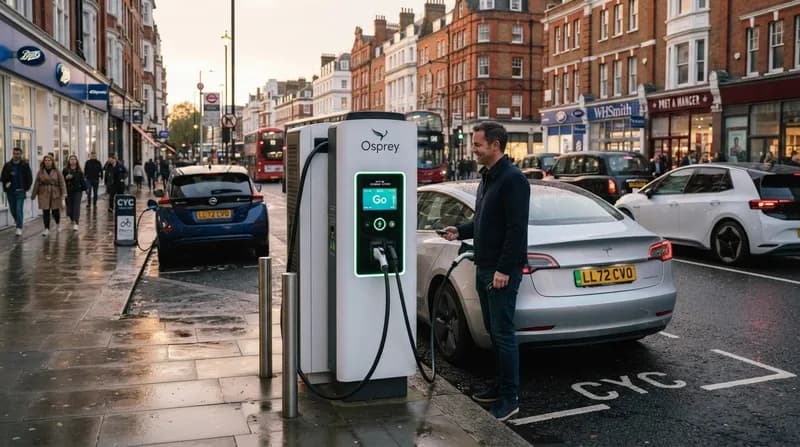
The UK charging landscape is taking a significant step forward as Osprey Charging officially launches its new 'Osprey Go' service. Billed as the largest Autocharge rollout in the United Kingdom, this initiative aims to remove the friction often associated with public EV infrastructure. By allowing the vehicle to communicate directly with the charging station, Osprey eliminates the need for physical payment cards or cumbersome app interactions, creating a 'plug-and-play' experience that feels remarkably modern.
The setup process is designed to be straightforward for users already familiar with the Osprey ecosystem. After a driver uses an Osprey charger twice, the 'Go' feature becomes available for activation within the mobile application. Once enabled, the charger recognizes the specific vehicle upon connection, automatically initiating the session and processing payment through the user's pre-linked account. This proprietary system, built on the company's internal 'Osprey Iris' software platform, marks a milestone in the company’s efforts to modernize its infrastructure.
Why It Matters
- Reduced Friction: Eliminates the 'app fatigue' or payment card failures that can plague public charging stops.
- Dynamic Pricing: Alongside the launch, Osprey is introducing dynamic tariffs, incentivizing drivers to utilize chargers during off-peak hours to reduce strain on the grid and lower costs.
- Proprietary Tech: Developed entirely in-house, the service showcases the growing sophistication of charging network operators who are increasingly becoming software companies in addition to energy providers.
Technical Distinctions: Autocharge vs. Plug & Charge
While 'Osprey Go' offers an experience that mirrors the industry-standard Plug & Charge, it is important to distinguish the technical underpinnings. Plug & Charge typically relies on the ISO 15118 international standard, which utilizes digital certificates stored within the vehicle itself to authenticate with any compliant network. In contrast, Autocharge—the technology underpinning Osprey Go—operates via the charging network's own backend. It identifies the vehicle as it is plugged in and maps that specific connection to the user's pre-registered account.
Currently, the service is optimized for vehicles equipped with a Combined Charging System (CCS) port. While the majority of modern EVs on the market utilize this standard, Osprey notes that not every vehicle will be compatible at launch. The company remains committed to future-proofing its network and has confirmed that it is actively exploring the full integration of ISO 15118 Plug & Charge standards as the industry moves toward a more unified, cross-network authentication protocol.
Looking Ahead
The deployment of Osprey Go highlights a strategic shift toward user-centric design in the EV sector. By controlling the development cycle in-house, Osprey has been able to iterate rapidly, moving from beta testing with real-world drivers to a full-scale national deployment. As the UK's EV adoption continues to climb, these types of intelligent, automated systems will become the baseline expectation for consumers who demand the same level of convenience at a charging station that they enjoy at a traditional gas pump.