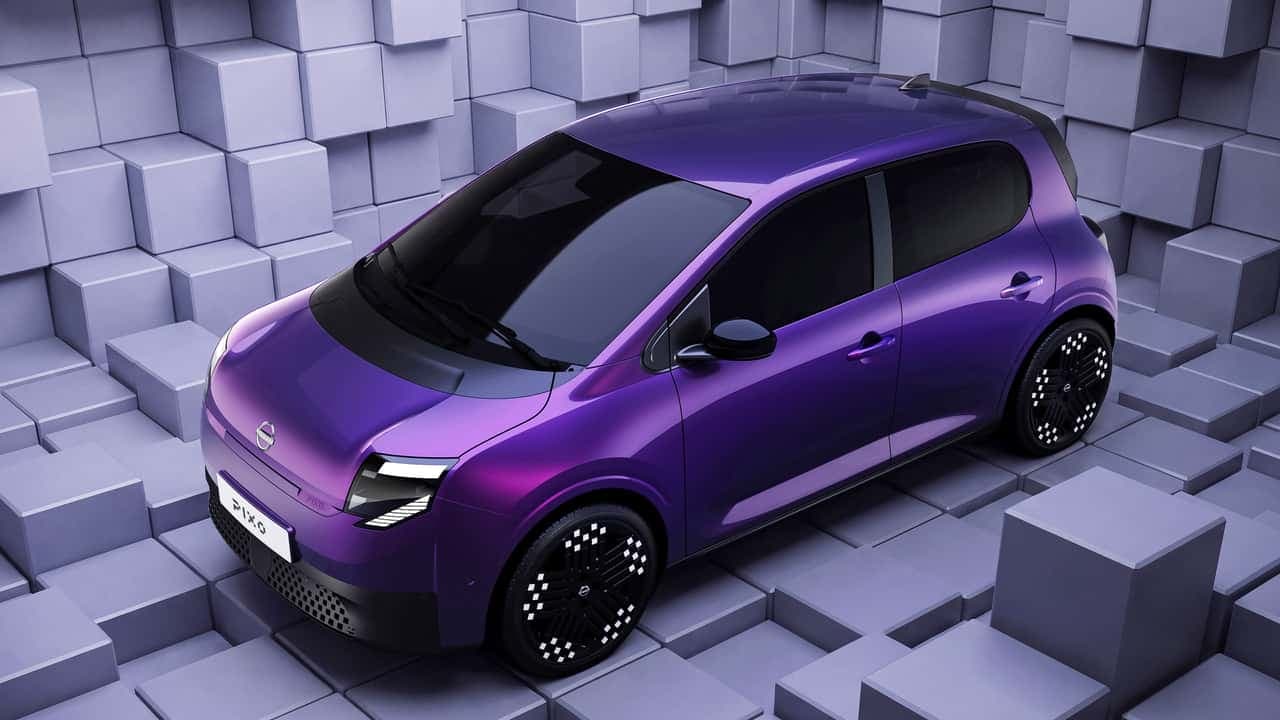
The Arrival of the Nissan Pixo
Nissan has officially pulled the cover off its latest electric vehicle, the Pixo, a compact city car designed to navigate tight European streets with ease. While the Pixo wears the Nissan badge, it is built upon a familiar foundation: the architecture underpinning the Renault Twingo E-Tech. By sharing development costs and engineering resources, Nissan is rapidly entering the budget-friendly EV segment with a vehicle that prioritizes urban agility and standardized performance.
From a design standpoint, the Pixo carves out its own personality despite its shared roots. It features a distinct front fascia that breaks away from the Twingo aesthetic, opting for a chunkier, more angular nose that establishes a unique identity. However, the side profile and greenhouse remain consistent with its Renault sibling, as does the rear, which sports a redesigned, sharp-edged light signature. Inside, the Pixo retains practical versatility, such as the independently sliding rear seats that allow owners to toggle between increased legroom and greater cargo capacity on demand.
Shared Engineering and Performance Specs
Under the skin, the Pixo is effectively part of a three-way sibling rivalry alongside the Renault Twingo E-Tech and the Dacia Spring. All three vehicles utilize a simplified version of the platform designed for the larger Renault 5 and the forthcoming Nissan Micra EV. This strategic commonality ensures that the Pixo hits consistent performance targets suitable for city environments.
- Battery: 27.5-kilowatt-hour Lithium-Iron-Phosphate (LFP) pack.
- Motor: Front-mounted motor outputting 80 horsepower and 129 lb-ft of torque.
- Performance: 0-62 mph acceleration in 11.9 seconds with an 81 mph top speed.
- Range: Approximately 161 miles (259 km) on the WLTP cycle.
- Dimensions: 149.4 inches total length with a 98.1-inch wheelbase.
The Pixo stands out in the charging department by coming standard with 50 kW DC fast-charging capabilities and an 11 kW AC onboard charger. This configuration allows the vehicle to reach an 80% charge in approximately 30 minutes, keeping it competitive with rivals that often relegate faster charging to optional hardware packages. By producing all three models at the same facility in Novo Mesto, Slovenia, the manufacturers are successfully balancing production efficiency with localized market competition.
Why It Matters
The introduction of the Nissan Pixo is a strategic move to democratize electric mobility. By leaning into modular platforms and shared hardware with Renault and Dacia, Nissan is able to bring a vehicle to market with a significantly compressed development timeline. This approach is essential for established automakers currently facing pressure from low-cost Chinese EV imports. While pricing for the Pixo remains under wraps, its position relative to the Dacia Spring (starting around €17,900) and the Twingo (starting around €19,500) suggests it will be a highly attractive option for European buyers seeking a reliable, city-focused electric runabout.