E-BUZZ ME Logo
ScienceTechnical Deep Dive

New Class of Magnons Exhibits Hundred-Fold Increase in Lifespan

Published
New Class of Magnons Exhibits Hundred-Fold Increase in Lifespan
1 min read131 words

The Gist

A breakthrough discovery of long-lived magnons could pave the way for scalable, nanoscale quantum information technologies on-chip.

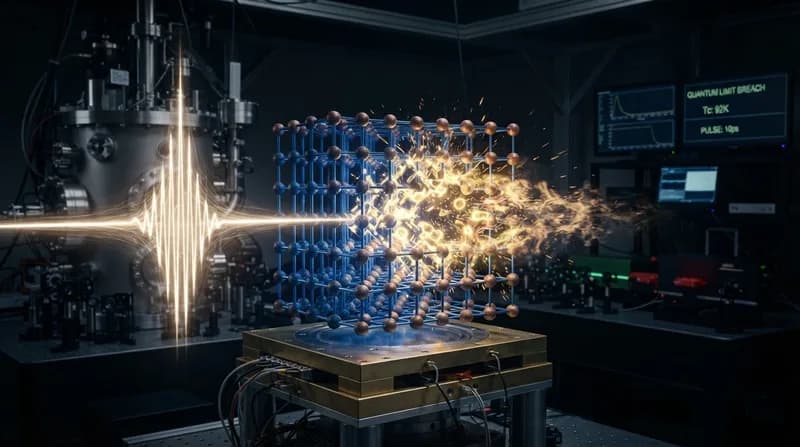
Researchers have identified a new class of magnons—quasiparticles representing collective excitations of electron spins—that persist up to a hundred times longer than previously observed variants. This significant extension in lifespan addresses one of the primary hurdles in utilizing spin-based excitations for data processing.

Advancing Quantum Circuitry

The discovery is particularly relevant for the development of on-chip quantum information technologies. Because these magnons maintain their state for a longer duration, they offer a more stable medium for transmitting and storing information at the nanoscale. This stability is crucial for creating functional quantum components that can be integrated into compact, high-performance circuits.

By enabling quantum information to be scaled down to the nanoscale without immediate decoherence, this finding provides a vital building block for the next generation of energy-efficient computing and advanced sensors.


Related Stories

Semantically matched articles, ranked by topic overlap and freshness.

GPS Satellite Network Provides Two Decades of Space Radiation Data
Science68%

GPS Satellite Network Provides Two Decades of Space Radiation Data

A massive cross-calibration effort involving 25 GPS satellites has unlocked twenty years of continuous space radiation tracking.

The Physics Behind the Snap: Understanding the Venus Flytrap
Science68%

The Physics Behind the Snap: Understanding the Venus Flytrap

New research delves into the complex physics that allows the Venus flytrap to snap shut with incredible speed to capture its prey.

John Bell and the Legacy of the Journal 'Physics'
Science67%

John Bell and the Legacy of the Journal 'Physics'

A look back at the short-lived journal where John Bell published his ground-breaking theorem, forever changing our understanding of quantum mechanics.

The Future of Open Access: Navigating Structural Challenges and AI Integration
Science67%

The Future of Open Access: Navigating Structural Challenges and AI Integration

As the scientific community pushes for an open-access future, experts warn that systemic issues and the rise of AI must be addressed to ensure sustainability.

Sweden Explores Rare Earth Deposits to Challenge Global Supply Dominance
Science66%

Sweden Explores Rare Earth Deposits to Challenge Global Supply Dominance

Researchers are mapping Sweden's mineral wealth to create magnets from natural element combinations, aiming to reduce reliance on Chinese exports.

New Giant Salamander Species Identified from 3.5-Million-Year-Old Japanese Fossils
Science60%

New Giant Salamander Species Identified from 3.5-Million-Year-Old Japanese Fossils

Researchers have identified a new genus and species of giant salamander, Limnospondylus ajimuensis, from fossils originally discovered over two decades ago.

Sulfur-Based Compound Identified as Potential Breakthrough for Aging Muscle Repair
Science59%

Sulfur-Based Compound Identified as Potential Breakthrough for Aging Muscle Repair

Researchers have discovered a compound named LASSS that protects proteins essential for muscle recovery, offering hope for combating age-related muscle loss.

Self-Repairing Bio-Textiles: Scientists Create Clothing From Living Fungi
Science58%

Self-Repairing Bio-Textiles: Scientists Create Clothing From Living Fungi

Researchers have developed a revolutionary biodegradable textile using the parasitic fungus Cordyceps militaris that can clean and repair itself.