1. Saturn at Opposition
The month kicks off with a major astronomical event on October 4th, as Saturn reaches opposition. This planetary configuration occurs when Earth passes directly between the Sun and the ringed giant, positioning Saturn at its closest and brightest point relative to our vantage point for the entire year. During this window, the planet rises right around sunset and remains a visible feature in the night sky through the early morning hours, providing an excellent target for amateur astronomers with backyard telescopes.
Beyond its visual splendor, Saturn is currently the subject of intense atmospheric study. Researchers have long been fascinated by the mysterious hexagonal jet stream encircling the planet's north pole, which spans roughly 20,000 miles. Adding to this intrigue, recent data from the Hubble Space Telescope has identified a new, robust ten-sided atmospheric wave structure near the south pole. Observing this southern feature as it intensifies provides scientists with a unique opportunity to track the evolution of massive, long-lived weather patterns on a gas giant.
2. The Orionid Meteor Shower
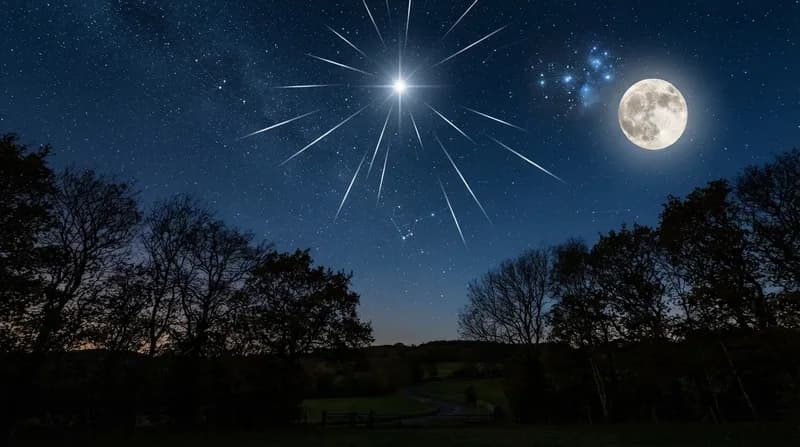
As October progresses, the night sky prepares for the annual return of the Orionids. Peaking between the night of October 21st and the morning of October 22nd, this meteor shower is a direct result of Earth passing through the debris trail left behind by the iconic Halley’s Comet. While these meteors technically radiate from the constellation Orion, they can appear anywhere across the celestial dome, often manifesting as fast-moving streaks that occasionally leave glowing trails.
Visibility for the 2026 Orionids presents a slight challenge due to a bright waxing gibbous Moon that may wash out fainter streaks. To maximize the viewing experience, observers are encouraged to venture out during the pre-dawn hours of October 22nd, specifically after the Moon has set. Finding a location shielded from artificial light pollution and allowing at least twenty minutes for eyes to adapt to the darkness will be the best strategy for catching the most vibrant displays.
3. The Moon Meets the Seven Sisters
The final celestial highlight occurs on the night of October 27th into the 28th, featuring a close visual encounter between the Moon and the Pleiades star cluster. Also known as the "Seven Sisters," this open cluster has served as a cultural touchstone for civilizations across the globe for millennia. Because the cluster is visible from almost every latitude on Earth, it holds a unique place in the history of global astronomy and folklore.
On this night, viewers should look toward the eastern horizon during the evening hours as both the Moon and the Pleiades ascend. To the naked eye, the cluster appears as a delicate, fuzzy grouping of stars, though the presence of a nearby crescent Moon will add a striking contrast to the scene. While no special optics are strictly necessary to enjoy the proximity of these objects, using binoculars or a small telescope can resolve the individual stars of the cluster, revealing the intricate beauty of this ancient gathering of young, hot stars.
Why It Matters
Events like these remind us that even without professional equipment, the night sky remains a dynamic laboratory. Tracking planetary atmospheric changes, remnants of historical comets, and the movement of nearby star clusters provides a tangible connection to the broader cosmos and underscores the importance of ongoing space observation initiatives, such as those conducted by NASA's Jet Propulsion Laboratory.