ScienceTechnical Deep Dive

Neural Cinema: How Scientists Reconstructed Sight from Mouse Brain Activity

Published
EElectricBuzz Editorial Team
Neural Cinema: How Scientists Reconstructed Sight from Mouse Brain Activity
3 min read514 wordsElectricBuzz Editorial Team

The Gist

Researchers at University College London have successfully reconstructed video footage by decoding neural signals from a mouse's visual cortex, offering a new window into how our brains interpret reality.

The Mechanics of Neural Decoding

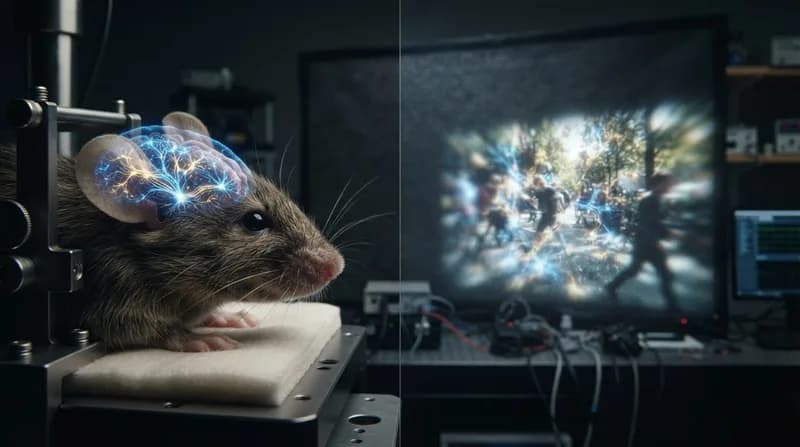
In a pioneering study published in the journal eLife, neuroscientists at University College London (UCL) have successfully bridged the gap between raw neural activity and visual perception. By utilizing high-resolution recordings from the visual cortex of mice, the research team managed to reconstruct 10-second video clips that closely mirror what the animals were observing. Unlike previous human-centric studies that relied on broad fMRI data, this project focused on individual neurons, allowing for a much more granular understanding of how visual information is encoded.

The process relied on a dynamic neural encoding model originally designed for the 2023 Sensorium Competition. The model accounts for more than just raw visual input; it integrates behavioral variables such as pupil diameter changes and the physical movement of the mouse. By observing calcium level fluctuations within the visual cortex, the researchers mapped out how individual brain cells responded to specific stimuli. The algorithm then performed a sophisticated iterative process, starting from a blank screen and gradually adjusting pixels until the generated output matched the neural activation patterns recorded during the original observation.

Why it matters: Perception vs. Reality

This breakthrough is not merely a technical novelty; it strikes at the heart of cognitive science. Scientists have long debated whether our vision acts as a faithful, camera-like recording of the world or a highly curated interpretation. This study suggests the latter. By identifying the subtle differences between the actual video shown and the neural reconstruction, researchers can begin to isolate the specific features that the brain prioritizes, filters, or warps during processing.

  • Precision Mapping: By moving beyond fMRI to single-cell measurements, the team captured a much higher resolution of neural activity than previously possible.
  • Dynamic Encoding: The model accounts for biological context, such as pupil size and physical movement, ensuring a more holistic representation of sensory intake.
  • Unseen Stimuli: The model proved its versatility by successfully reconstructing videos that were entirely absent from its initial training dataset, proving it wasn't just memorizing visuals.
  • Evolutionary Implications: This technique creates a standardized framework for comparing visual perception across different species, potentially unlocking new insights into animal behavior and consciousness.

Outlook and Future Implications

The success of these 10-second reconstructions marks a significant departure from static image analysis. Dr. Joel Bauer and his team at the Sainsbury Wellcome Centre are already looking ahead to the next phase of development. Future iterations of the model aim to improve image resolution and expand the field of view, capturing a larger portion of the visual environment. This trajectory could eventually allow for a near-real-time view of how internal representations of reality differ from physical surroundings.

By highlighting the "warping" of visual data, this research supports the theory that biological perception is inherently interpretive rather than objective. As this technology matures, it may offer profound insights into neural pathologies and provide a clearer picture of how cognitive errors or sensory disruptions occur within the brain. For now, the ability to play back what a living creature sees from its own brain activity represents a milestone in both neuroscience and digital signal processing.


The 5 Best Over-Ear ANC Headphones of 2026, Tested & Ranked
Editor's Pick Guide
92/100
Tech & Gadgets12 min read

The 5 Best Over-Ear ANC Headphones of 2026, Tested & Ranked

We locked five over-ear ANC picks for 2026 — Sony WH-1000XM6, Bose QuietComfort Ultra 2, Soundcore Space One, Sennheiser Momentum 5, and Apple AirPods Max 2 — then stress-tested them on lab metrics, long-term owner truth, and live street prices.

Related Stories

Semantically matched articles, ranked by topic overlap and freshness.

NASA's Roman Space Telescope Set for Two Decades of Cosmic Discovery
Science

NASA's Roman Space Telescope Set for Two Decades of Cosmic Discovery

Thanks to exceptional launch precision and significant fuel savings, the Nancy Grace Roman Space Telescope is poised to more than double its mission life, potentially operating for over 22 years.

Unlocking Predictive Markers: How B Cells Could Forecast Immunotherapy-Induced Colitis
Science

Unlocking Predictive Markers: How B Cells Could Forecast Immunotherapy-Induced Colitis

New research from MD Anderson Cancer Center suggests that B cell activity acts as a crucial early-warning system for identifying patients at risk of developing severe colitis during cancer treatment.

Could a Tiny Brain Protein Be the Master Switch for Aging?
Science

Could a Tiny Brain Protein Be the Master Switch for Aging?

Researchers have identified that declining levels of a brain protein called Menin may drive systemic aging, offering a potential new target for age-related health interventions.

Challenging Einstein: Scientists Pioneer Gravity Tests Using Exotic Muonium Atoms
Science

Challenging Einstein: Scientists Pioneer Gravity Tests Using Exotic Muonium Atoms

Researchers at ETH Zurich have developed a method to create controlled beams of muonium, potentially enabling the first-ever gravitational tests on second-generation particles.

Unlocking the Narrative: AI System Transforms Physician Notes into Actionable Medical Data
Science

Unlocking the Narrative: AI System Transforms Physician Notes into Actionable Medical Data

A groundbreaking study reveals how a new AI system can parse clinical prose at scale, converting hidden patient insights into verifiable, computer-readable data.

Caltech’s Femtosecond Breakthrough: Steering Light with Light
Science

Caltech’s Femtosecond Breakthrough: Steering Light with Light

Researchers have engineered a nanoscale silicon metasurface capable of redirecting light beams in just 74 quadrillionths of a second, shattering traditional speed barriers in photonic computing.

Beyond the Starch: Why Black and Green Rice Are Emerging as Metabolic Superfoods
Science

Beyond the Starch: Why Black and Green Rice Are Emerging as Metabolic Superfoods

New research from Hokkaido University reveals that pigmented rice varieties contain unique, beneficial fats that could revolutionize dietary approaches to blood sugar management.

Biological Breakthrough: Scientists 3D-Print a Functional Human Gut-on-a-Chip
Science

Biological Breakthrough: Scientists 3D-Print a Functional Human Gut-on-a-Chip

Researchers at Lawrence Livermore National Laboratory have successfully replicated the complex 3D architecture of the human small intestine on a compact, microfluidic device.