A Sustainable Solution to the Global Water Crisis
As global water scarcity continues to threaten over 2 billion people, conventional desalination methods have long been a double-edged sword. While reverse osmosis and thermal distillation provide essential drinking water, they rely on energy-intensive processes and produce massive amounts of brine—a highly concentrated salt waste that, when pumped back into the ocean, wreaks havoc on marine ecosystems by depleting oxygen levels and increasing local salinity. However, a team of scientists at the University of Rochester has introduced a transformative, solar-powered alternative that promises to flip this script entirely.
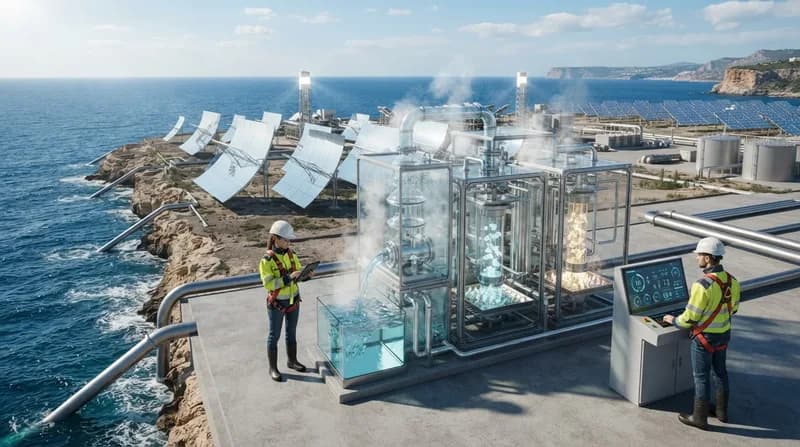
Led by Professor Chunlei Guo at the Institute of Optics, the research team has developed a novel solar thermal desalination device that operates without the need for chemical pre-treatments. By leveraging advanced laser technology, the device not only purifies seawater but captures salt and minerals in solid form, effectively ending the era of liquid brine discharge. This innovation transforms the desalination plant from a polluter into a potential resource hub.
The Engineering Behind the Breakthrough
The core of this system lies in specialized solar panels crafted from “black metal.” Using femtosecond lasers—capable of pulsing at one-quadrillionth of a second—researchers precisely etch microscopic structures onto the metal surface. This treatment achieves two critical engineering feats: it maximizes sunlight absorption and creates a "superwicking" surface where water spreads rapidly rather than beading up.
In operation, the panel draws a thin layer of seawater across its active region. As the solar-heated metal evaporates the water, minerals and salts are left behind. To prevent the inevitable mineral crusting that typically clogs desalination systems, the team utilized the "coffee ring effect." Just as a spilled drop of coffee leaves a concentrated ring at its edge as it dries, the panel’s microscopic grooves are designed to guide salts toward a passive region at the side of the device. This ensures the active surface remains clean and efficient, even when processing complex, mineral-heavy real-world seawater.
Resource Extraction: Harvesting Lithium from Salt
Perhaps the most compelling aspect of this technology is its ability to turn waste into a valuable economic commodity. Instead of creating toxic discharge, the system extracts salts as solids. By modifying the panels with hydrogen titanate nanoparticles, researchers can selectively isolate lithium, a critical component for the global shift toward electric vehicle batteries and consumer electronics.
Testing with samples from the Great Salt Lake demonstrated that the system could recover approximately 50 percent of the lithium present in the leftover salts. By harvesting these minerals during the desalination process, the technology offers a dual benefit: it provides clean water while offering a sustainable, localized supply chain for battery materials, significantly reducing the environmental impact of traditional, land-heavy mining operations.
Why it Matters
- Eliminating Brine: The system produces zero liquid discharge, preventing the ecological damage caused by traditional brine dumping.
- Dual Utility: It simultaneously addresses the global need for fresh water and the soaring demand for lithium.
- Energy Efficiency: By utilizing direct solar-thermal evaporation, the technology reduces the reliance on electricity-heavy reverse osmosis pumps.
- Scalability: While currently in proof-of-concept stages, the modular, passive nature of the panel design suggests that it can be scaled for industrial, municipal, or remote applications.
As the team continues to refine this technology, the potential for widespread adoption grows. By turning the ocean’s greatest waste product—salt—into a resource, this innovation represents a significant step forward in our ability to manage the planet’s natural resources more responsibly.