ScienceTechnical Deep Dive

NASA Pinpoints Earth’s Shifting Center of Mass with New Satellite Precision

Published
EElectricBuzz Editorial Team
NASA Pinpoints Earth’s Shifting Center of Mass with New Satellite Precision
3 min read542 wordsElectricBuzz Editorial Team

The Gist

“A groundbreaking study has revealed that Earth's center of mass is constantly in motion, with NASA researchers unveiling a high-precision method to track the seasonal dance of our planet's weight.”

The Dynamic Pulse of Our Planet

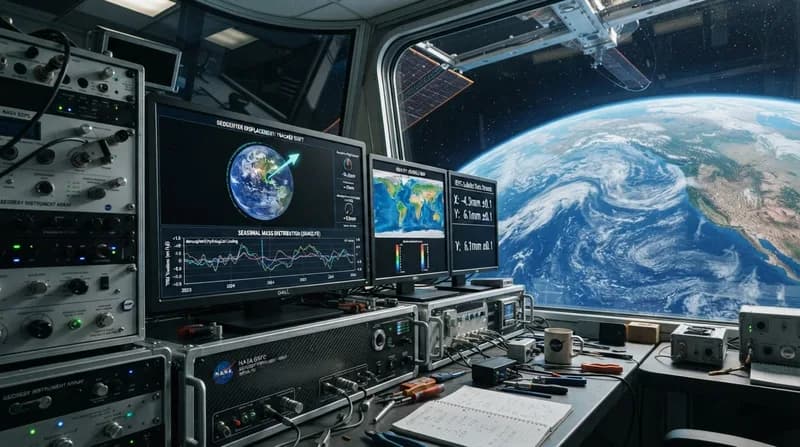
Earth is far from a static, solid object. Beneath our feet, a massive, seasonal reshuffling of water, ice, and air constantly alters the planet’s internal balance. NASA researchers have recently quantified this phenomenon, proving that Earth's center of mass—the theoretical point around which the planet orbits—swings by several millimeters throughout the year relative to its geometric center. This motion, driven by the massive migration of Earth's surface materials, has been successfully mapped with unprecedented accuracy by a team led by the Jet Propulsion Laboratory (JPL).

Understanding these shifts is more than a purely academic exercise. Because modern satellite navigation and geophysical mapping rely on a fixed reference point, even a discrepancy of a few millimeters can impact the precision of critical global infrastructure. Previous international estimates regarding this movement varied by as much as seven millimeters—a significant gap that researchers have finally narrowed using a sophisticated new methodology.

Refining the Measurement Technique

To achieve this level of precision, the research team utilized a multi-faceted approach that goes beyond standard satellite observations. By synthesizing laser-ranging data from specialized satellites like LAGEOS 1 and 2—which act as orbiting “disco balls” for ground-based laser stations—with modern GPS tracking and orbital data from low Earth orbit spacecraft, the scientists created a more comprehensive model. Crucially, they also accounted for the deformation of Earth’s crust, recognizing that the very ground beneath monitoring stations shifts as water and ice loads fluctuate.

This refined technique suggests that the annual movement of Earth’s mass center is approximately half of what was estimated just eight years ago. By understanding how the planet’s crust bows and flexes under seasonal loads, the team has effectively removed the 'noise' that previously obscured the true magnitude of these shifts, paving the way for more reliable navigation and mapping systems used in everything from logistics to high-tech agriculture.

Why It Matters

  • Enhanced Navigation: Increased precision in reference systems directly improves GPS reliability for global shipping and autonomous logistics.
  • Climate Monitoring: Measuring mass redistribution provides an indirect but powerful metric for tracking the movement of water, ice, and atmospheric density on a planetary scale.
  • Future Missions: These findings provide a necessary baseline for the upcoming GRACE-Continuity (GRACE-C) mission, ensuring that two decades of gravitational data remains consistent and actionable.

The Drivers of Planetary Motion

The research identifies three primary drivers for the wobble: continental water, atmospheric pressure, and oceanic currents. Snow accumulation across North America and Eurasia in the spring, for instance, adds enough mass to pull the planet’s center toward the North Pole by about three millimeters. Similarly, the seasonal maximum of the Amazon River basin acts as a massive weight, drawing the center toward South America by over two millimeters each April.

The oceans, particularly the Pacific, exert the most significant influence on the cycle. As water redistributes from late summer through autumn, it creates a gravitational pull that shifts the center toward the South Pacific. When combined with the seasonal atmospheric pressure shifts—where cold, dense winter air displaces the center toward Eurasia and Northern Africa—the complex, rhythmic dance of Earth’s mass becomes clear. These findings are further corroborated by the GRACE-FO mission, which continues to provide a vital perspective on the gravitational nuances that govern our planet's behavior.

SPONSORED
The 5 Best Over-Ear ANC Headphones of 2026, Tested & Ranked
Editor's Pick Guide
92/100
Tech & Gadgets•12 min read

The 5 Best Over-Ear ANC Headphones of 2026, Tested & Ranked

We locked five over-ear ANC picks for 2026 — Sony WH-1000XM6, Bose QuietComfort Ultra 2, Soundcore Space One, Sennheiser Momentum 5, and Apple AirPods Max 2 — then stress-tested them on lab metrics, long-term owner truth, and live street prices.

Related Stories

Semantically matched articles, ranked by topic overlap and freshness.

Sugar Intake Could Be Fueling Microbiome Damage During Antibiotic Treatment
Science

Sugar Intake Could Be Fueling Microbiome Damage During Antibiotic Treatment

New research reveals a significant link between dietary sugar consumption and intensified gut microbiome disruption for patients taking antibiotics.

Scaling Up: How Pooled Sputum Testing Could Eradicate TB's 'Missed Millions'
Science

Scaling Up: How Pooled Sputum Testing Could Eradicate TB's 'Missed Millions'

A landmark global study reveals that pooling sputum samples can double testing capacity for tuberculosis, effectively cutting costs and reaching thousands more patients.

Breakthrough Lung Organoids With Integrated Immune Systems Could Revolutionize Respiratory Medicine
Science

Breakthrough Lung Organoids With Integrated Immune Systems Could Revolutionize Respiratory Medicine

Researchers at Stanford Medicine have engineered human lung organoids that possess their own functional immune systems, offering a new, animal-free pathway for studying respiratory diseases and testing local vaccination strategies.

Cosmic Car Crashes: Webb Telescope Reveals Secrets of Violent Planetary Collisions
Science

Cosmic Car Crashes: Webb Telescope Reveals Secrets of Violent Planetary Collisions

NASA's James Webb Space Telescope has uncovered evidence of high-energy planetary impacts in distant star systems, offering a mirror into our own Moon's violent origins.

Groundbreaking In Vivo CRISPR Breakthrough Could Revolutionize Cancer Therapy
Science

Groundbreaking In Vivo CRISPR Breakthrough Could Revolutionize Cancer Therapy

Researchers at UCSF have successfully reprogrammed immune cells directly inside the body, potentially eliminating the need for complex, costly, and time-consuming laboratory manufacturing in cancer treatment.

Mitochondrial DNA Levels Emerges as a New Frontier in Cancer Diagnostics
Science

Mitochondrial DNA Levels Emerges as a New Frontier in Cancer Diagnostics

A recent study identifies mitochondrial DNA copy number as a pivotal marker for tumor progression and chemotherapy response, opening new doors for precision oncology.

Unlocking the Neural Mechanism Behind Cannabis-Induced Anxiety
Science

Unlocking the Neural Mechanism Behind Cannabis-Induced Anxiety

Researchers at Northwestern University have identified specific neurons in the brain’s fear center that trigger anxiety during cannabis use, potentially paving the way for new clinical treatments.

Silencing the Signal: A Revolutionary Approach to Combating Gum Disease
Science

Silencing the Signal: A Revolutionary Approach to Combating Gum Disease

Researchers have discovered a breakthrough method to treat gum disease by disrupting bacterial communication rather than using traditional, indiscriminate antibiotics.