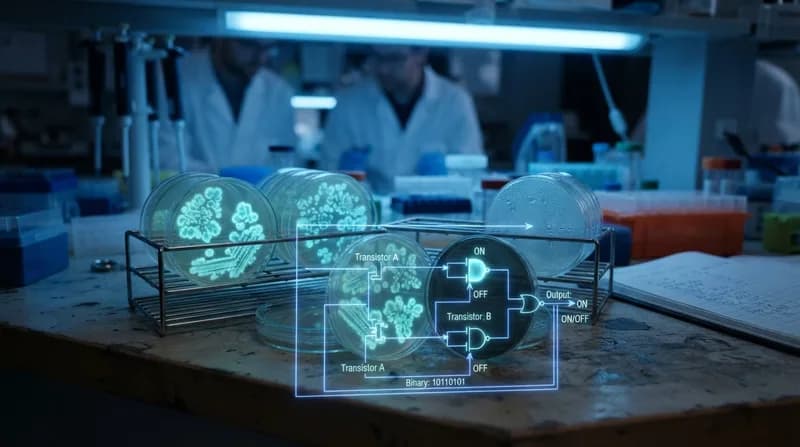
A Biological Leap in Computational Design
Researchers at the Massachusetts Institute of Technology have achieved a breakthrough in synthetic biology by successfully engineering bacterial cells to function as transistors. This development allows for the creation of living circuit boards that can be printed onto growth media, essentially merging the logic of electronic systems with the adaptability of biological organisms. By moving away from cramming complex genetic circuits into a single cell, the team has bypassed traditional limitations on circuit density and protein production, enabling a modular approach to bio-computing.
In standard electronics, transistors serve as critical switches that dictate the flow of current. In this biological iteration, engineered Pantoea agglomerans bacteria regulate the movement of small signaling molecules, which act as the information carriers across the system. By developing a set of five distinct bacterial strains—two that act as functional transistors and three that serve as signal relays—the researchers have created a flexible, Lego-like architecture capable of performing sophisticated logical operations.
The Mechanics of Living Logic
The design utilizes chemical signaling to replicate the gate-logic found in traditional silicon processors. Each bacterial transistor is engineered to sense specific target molecules, switching states based on the presence of these inputs. For instance, the system can be configured to process 'AND,' 'OR,' or 'IMPLY' gates. When a transistor is triggered, it emits a specific output molecule, which is then captured and converted by relay strains to serve as an input for the next colony in the sequence.
Physical arrangement is vital to the function of these circuits. By printing bacterial colonies onto agar plates with precise 5-millimeter spacing, the researchers ensure that chemical signals propagate in a controlled, single-direction flow. This spatial organization prevents signal interference, allowing complex logic—such as a circuit that adds two inputs together—to be performed by a network of 24 interconnected colonies. While these biological circuits operate on an eight-hour processing cycle, the team notes that for applications like agricultural monitoring, this speed is more than sufficient.
Why It Matters
- Scalability: By modularizing transistors across multiple cells, researchers can bypass the bottleneck of protein production capacity within a single cell.
- Agricultural Resilience: These circuits could eventually be integrated into plant roots or leaves, acting as autonomous diagnostic tools that detect pests, drought, or nutrient deficiencies.
- Targeted Response: Once a threat is detected, the living computer could trigger a localized defense, such as the secretion of protective fungicides, without human intervention.
Future Outlook: Beyond the Petri Dish
While the prospect of 'biological computers' may sound like science fiction, the practical implications for agriculture and environmental sensing are significant. The research, which was supported by DARPA and IARPA, suggests a future where plants themselves are equipped with synthetic intelligence to survive changing climates. Although these systems are not intended to compete with the speed of silicon-based microprocessors found in iPhones, they provide a powerful, low-power computational layer that can operate harmoniously within organic environments. As the technology matures, we may see the transition of these living circuits from controlled laboratory settings into the complex, real-world ecosystems of our global food supply.