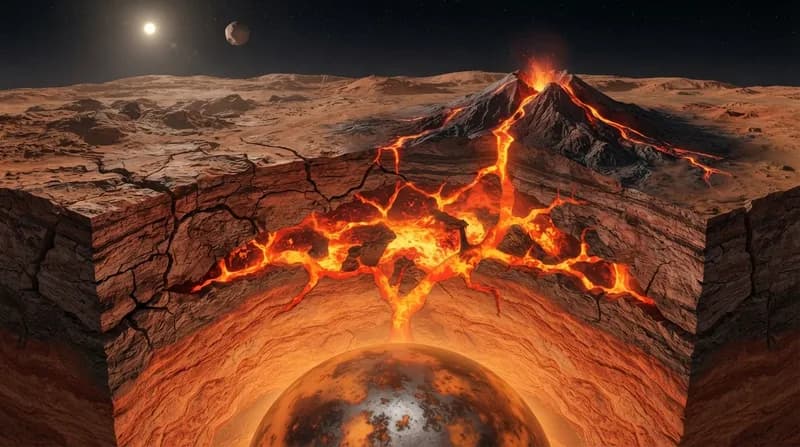
Challenging the Martian Stagnant Lid Theory
For decades, planetary scientists have classified Mars as a 'stagnant lid' planet. Unlike Earth, which is characterized by the constant grinding and shifting of tectonic plates, Mars was believed to possess a relatively simple, static outer shell. This distinction was central to our understanding of why Earth developed into a bustling, life-supporting world, while Mars became a cold, barren desert. However, a groundbreaking new study published in Nature Astronomy suggests that Mars is far more geologically complex than we ever imagined.
Researchers from the University of Oxford, utilizing seismic data harvested by NASA's InSight lander, have uncovered evidence of extensive magmatic systems deep beneath the Martian surface. This discovery fundamentally alters the consensus that Earth-like geological complexity requires the engine of plate tectonics. Instead, it appears that Mars may have engaged in its own form of internal recycling, utilizing large-scale magma processing to evolve its crust over millions of years.
The 24-Kilometer Boundary
The discovery centers on a mysterious, previously unexplained seismic boundary located approximately 24 kilometers below the Martian surface. By cross-referencing seismic waves produced by meteorite impacts and marsquakes with complex thermodynamic models, the team successfully identified the composition of the rocks surrounding this divide. The results showed a distinct transition: beneath the boundary lie ultramafic rocks, rich in iron and magnesium, while the layer above consists of mafic rocks with higher silica concentrations.
This layering points to a process known as 'transcrustal magmatism.' Historically, this process was viewed as a hallmark of Earth’s continental evolution, where molten rock accumulates, evolves chemically, and eventually differentiates. Finding this signature on Mars suggests that the Red Planet once possessed a dynamic engine capable of 'recycling' material through its crust on a continental scale, potentially spanning thousands of kilometers across the northern hemisphere.
Why It Matters: Redefining Habitability
The implications of this study extend well beyond simple geology; they strike at the heart of our search for life elsewhere in the universe. Geological recycling is essential for regulating a planet's climate, managing volatile elements, and maintaining the conditions necessary for life. Previously, scientists viewed plate tectonics as a prerequisite for this kind of crustal evolution, essentially disqualifying many rocky exoplanets from being 'habitable' if they lacked moving plates.
If Mars could develop such sophisticated, long-lived magma systems without plate tectonics, it opens the door for a vast new category of potentially habitable worlds. The existence of these systems suggests that complex crustal development may be a universal process for rocky planets, rather than a unique quirk of our own world. This realization may force astronomers to re-evaluate their criteria for 'life-supporting' conditions when surveying exoplanets orbiting distant stars, as size and apparent tectonic activity may not be the definitive benchmarks for habitability that we once believed.
Looking Ahead
As we continue to synthesize the wealth of data provided by the retired InSight mission, the image of Mars continues to shift from a dead, monolithic ball of rock to a planet with a rich, hidden, and dynamic past. This research highlights that the ingredients for a complex, evolved environment might be present on many more worlds than current models suggest, providing a vital roadmap for future exploration missions that seek to understand the origins and distribution of life in the cosmos.