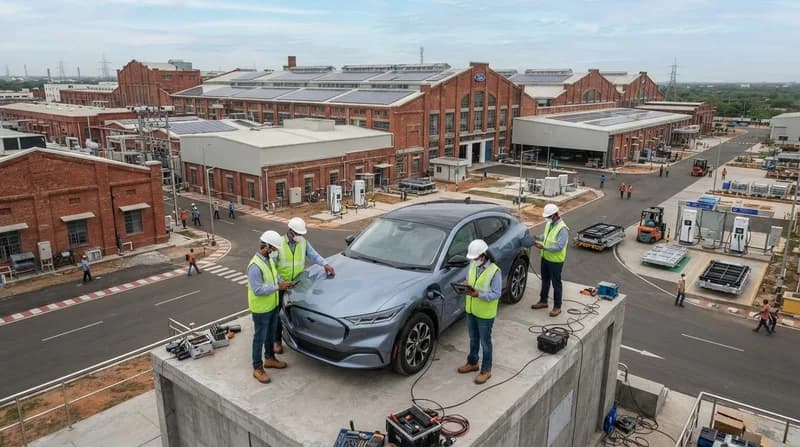
Reviving the Blue Oval in Chennai
In a move that signals a significant shift in its global strategy, Ford is reportedly preparing to bring its idle manufacturing facility in Maraimalai Nagar, near Chennai, back to life. Having ceased all vehicle production at the site in 2022, the American automaker now appears to be eyeing the location for a high-stakes comeback focused entirely on the electric vehicle sector. According to recent reports, the company is looking to convert the dormant factory into an integrated hub capable of producing not just electric vehicles, but also critical core components including batteries, electric motors, and power cells.
While Ford has officially maintained that its current commitments involve a smaller investment focused on export-only powertrain manufacturing, the sheer scale of this potential pivot suggests a more ambitious vision. Industry analysts estimate that a full-scale conversion into an EV and battery production facility could involve investments ranging between 150 and 200 billion rupees, equivalent to approximately €1.4 to €1.8 billion. This would position the Chennai plant as a cornerstone of Ford’s Asia-Pacific strategy, focusing on the production of affordable electric vehicles for international markets.
The Universal EV Platform Strategy
Central to this potential expansion is Ford's upcoming Universal Electric Vehicle (UEV) platform. Designed for scalability and cost-efficiency, the UEV architecture is slated to make its debut with the launch of the Fathom, an entry-level electric pickup truck expected to hit the market in early 2027. The platform is highly versatile, engineered to support a wide spectrum of body styles, ranging from compact B-segment passenger cars to robust commercial utility vehicles.
By leveraging this platform in a low-cost, high-capacity environment like India, Ford could effectively streamline its manufacturing pipeline for the global transition to electrification. The ability to integrate cell and motor production on-site would further insulate the company from supply chain volatility, providing a significant competitive edge as it seeks to scale its budget-friendly EV offerings. While the company has not confirmed any plans to re-enter the Indian domestic automotive market, the infrastructure investment alone marks a major milestone in Ford's global manufacturing footprint.
Why it Matters
- Strategic Pivot: Transitioning from a shuttered legacy plant to a cutting-edge EV manufacturing hub represents a significant reversal of Ford’s 2021 withdrawal from Indian vehicle production.
- Cost Optimization: Utilizing the flexible UEV platform in a strategic regional hub allows Ford to target the high-demand affordable EV segment with improved cost structures.
- Vertical Integration: Moving beyond simple assembly to include battery and motor production highlights an industry-wide trend toward controlling the entire electric powertrain ecosystem.
Though the company remains tight-lipped regarding specific production timelines and intended export regions, the sheer scope of this development suggests that Ford is betting big on the future of electric mobility. Whether or not these plans fully manifest as an export powerhouse, the reactivation of the Chennai site confirms that Ford's appetite for EV dominance remains undiminished by its past regional footprint restructurings.