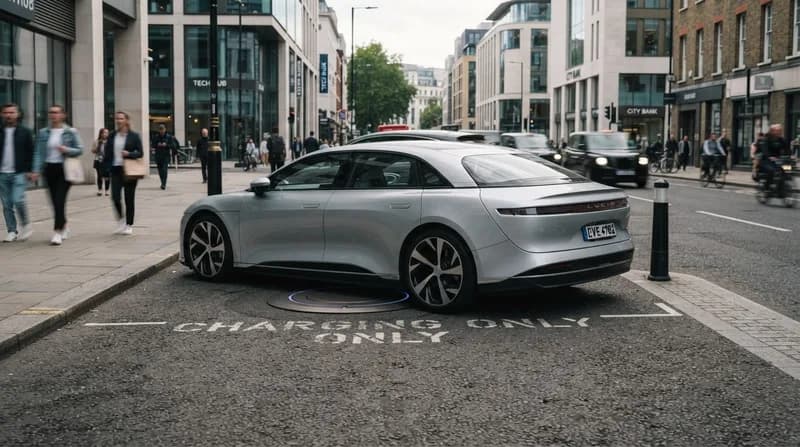
The Evolution of Wireless Charging
Electreon, a pioneer in the field of inductive energy transfer, has officially unveiled its latest innovation: Lite DOT. While the company has historically garnered attention for its high-power, in-road dynamic charging systems that keep vehicles powered while in motion, Lite DOT shifts the focus toward the stationary convenience of the everyday parking space. Designed for both private users and professional fleets, this system aims to eliminate the friction associated with physical cables by utilizing an automated wireless link.
How Lite DOT Works
At its core, the Lite DOT system centers on a surface-mounted charging pad that can be installed directly in an existing parking stall. Because the pad sits above ground, it avoids the intensive civil engineering and excavation work traditionally required for inductive infrastructure. The system is complemented by a wall-mounted module—which can be fixed to a garage wall or a dedicated support pole—that handles the power conversion and management.
The process is seamless: once a vehicle equipped with a specialized receiver is parked precisely over the pad, the system automatically detects the proximity and initiates the energy transfer. Capable of delivering up to 11 kW of power, the unit is designed to maximize the idle time a vehicle spends in a designated spot, making it an ideal candidate for commercial fleet depots where vehicles have frequent, predictable downtimes.
Durability and Integration
Electreon has prioritized ruggedness, ensuring that the Lite DOT is capable of functioning in diverse environments. The system is rated for an operating temperature range of -30 to +50 degrees Celsius, and its design is fully weather-resistant, maintaining performance through rain and snow. This versatility allows for deployment in both indoor garages and exposed outdoor parking lots.
While the hardware is robust, users gain additional oversight through the Electreon Flow Driver app, which monitors charging status and system health. It is important to note that the vehicle itself must be outfitted with a specific receiver unit, which Electreon plans to supply either directly or through strategic automotive partners. This requirement represents a shift toward more widespread adoption, as the company leverages its massive portfolio of over 400 patents—bolstered by its recent acquisition of InductEV—to refine the standard.
Why It Matters
- Eliminates Manual Labor: By removing the need to plug in a cable, Lite DOT serves as a critical bridge for the future of autonomous vehicles, which require automated energy replenishment to operate without human intervention.
- Fleet Optimization: For commercial operators, the ability to turn standard parking bays into charging stations reduces downtime and simplifies the logistical burden of fleet management.
- Low Barrier to Entry: The surface-mounted nature of the charging pad significantly lowers the financial and temporal costs of installation compared to traditional inductive solutions.
Strategic Implications
Lite DOT arrives at a pivotal time in the EV industry. While high-speed road charging continues to dominate headlines, the 'parking-based' charging model addresses the chronic issue of urban charging accessibility. By focusing on 11 kW, Electreon is acknowledging that not every charge needs to be a lightning-fast DC event; rather, many fleet and residential needs are better served by 'top-up' charging that occurs passively during normal stop times. This strategic pivot positions Electreon as a comprehensive player, capable of serving both the long-haul transit sector and the localized, everyday needs of modern electric vehicle owners.