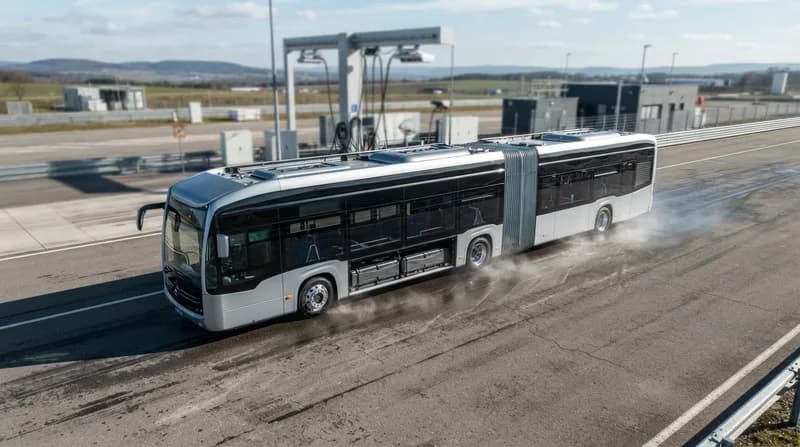
The ELCH Project Breakthrough
Daimler Buses has officially reached a critical development milestone in its quest to bring battery-electric coaches to the long-haul market. Through the government-funded Electrified Coach (ELCH) project, the company recently showcased a technology demonstrator that successfully completed real-world test drives in Neu-Ulm, Germany. The most significant finding from these trials is that the modular electric powertrain is capable of traveling over 500 kilometers on a single charge, a distance previously considered challenging for heavy-duty electric passenger vehicles.
Launched in 2022, the ELCH project represents a collaborative effort between Daimler Buses, academic researchers, and industry specialists, including the long-distance service provider Flix SE. The project is designed to build a foundation for future series-production coaches under the Mercedes-Benz and Setra brands. By integrating insights from these prototype vehicles, the company aims to move beyond simple electrification and focus on the holistic requirements of commercial long-distance transport, including energy management, aerodynamics, and structural lightweight design.
Collaborative Innovation
The success of the ELCH project relies on the diverse expertise of its consortium members. Each partner contributes a specific pillar of research essential to commercializing electric coaches:
- Karlsruhe Institute of Technology (KIT): Specializes in vehicle data analysis and the optimization of operating strategies to maximize battery efficiency.
- Rhineland-Palatinate Technical University (RPTU): Focused on advancing lightweight construction techniques and aerodynamics to boost range and efficiency.
- University of Mannheim (MISES): Provides an economic analysis, ensuring that the transition to battery-electric platforms remains viable for bus operators.
- Flix SE: Offers critical operational data and real-world usage patterns derived from their massive long-distance bus network to ensure the vehicle meets practical requirements.
Why It Matters
The transition to electric powertrains in the coach segment is significantly more complex than in city buses due to the demanding nature of intercity travel. High-speed highway driving and the necessity for minimal downtime require sophisticated thermal management and energy-dense battery packs. By focusing on a modular platform, Daimler Buses intends to create a scalable system that can adapt to various operational needs while maintaining economic competitiveness. This project provides the technical blueprint for the company's stated goal of launching series-production electric coaches by the end of the decade, signaling a major shift toward decarbonizing the European long-distance transit sector.