A New Perspective on Planetary Formation
For decades, the dominant narrative in planetary science has suggested that Earth was a cosmic mosaic, constructed from a blend of local inner-system rock and a significant portion of water-rich material transported from the outer reaches of the solar system, specifically from beyond the orbit of Jupiter. This theory was considered essential to explain how our planet acquired its volatile substances, most notably water. However, a new study led by planetary scientists Paolo Sossi and Dan Bower at ETH Zurich has upended this long-standing assumption, suggesting that Earth’s birth was a far more insular affair than previously imagined.
By applying advanced data science techniques to analyze isotope ratios across a vast array of meteorites, the team at ETH Zurich discovered that Earth’s chemical fingerprint matches only non-carbonaceous meteorites, which are exclusive to the inner solar system. Their findings indicate that material from the outer solar system accounts for less than two percent of Earth's total mass, potentially suggesting that it accounts for none at all. This conclusion directly contradicts the notion that significant material exchange occurred during the chaotic early stages of our solar system's development.
The Role of the Jovian Barrier
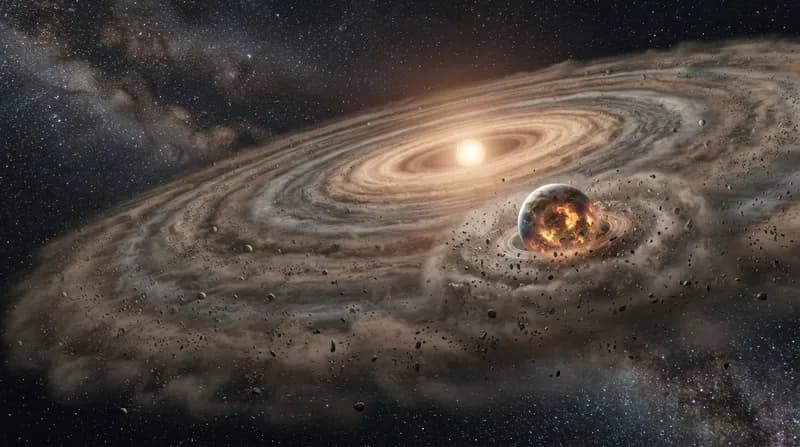
The research provides compelling evidence for the "Jovian barrier" hypothesis. As Jupiter matured into a gas giant, its immense gravitational influence likely carved a massive gap in the protoplanetary disc—the swirling cloud of dust and gas surrounding the young Sun. This gap acted as a celestial blockade, effectively walling off the inner solar system from the volatile-rich debris of the outer regions. This isolation meant that Earth grew in a stable, localized environment, accumulating mass from a single reservoir of materials.
The study utilized an innovative statistical approach rarely applied to geochemistry, relying on the analysis of ten different isotope systems found in meteorites. This comprehensive look allowed researchers to distinguish between inner-system "non-carbonaceous" bodies and outer-system "carbonaceous" ones. By confirming that Earth shares a distinct composition with neighbors like Mars and the asteroid Vesta, the team has bolstered the idea that the inner rocky planets share a common, local lineage that is starkly different from anything found further out.
Why It Matters
- Rewriting Origins: The findings challenge the conventional reliance on outer-system imports for Earth's water supply, necessitating a search for new explanations regarding the planet's volatile content.
- Methodological Innovation: By treating geochemical data as a "data science" problem, the researchers demonstrated how statistical rigor can override older, limited isotopic studies.
- Systemic Uniformity: The research suggests that the terrestrial planets—and potentially Venus and Mercury—followed a remarkably similar growth trajectory within their own restricted "inner" neighborhood.
The Water Paradox
Perhaps the most significant implication of this discovery is the mystery it creates regarding the source of Earth's oceans. If the planet did not receive a massive infusion of water-rich material from the outer solar system, then the water must have been present in the hot, inner region of the protoplanetary disc from the very beginning. This forces scientists to rethink the thermal history of the inner solar system and how it was able to retain water during the planet-building process. As the researchers move toward their next phase of study, they aim to apply these models to other star systems, questioning whether "local formation" is a universal rule for rocky planets across the galaxy.