A Dynamic Discovery in the Outer Solar System
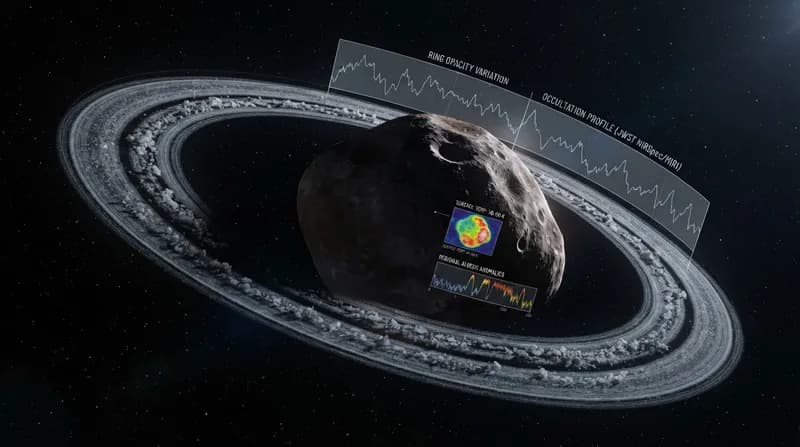
For decades, the concept of planetary rings was tethered to the gas giants of our solar system: Jupiter, Saturn, Uranus, and Neptune. This paradigm shifted dramatically in 2013 with the discovery of two dense rings encircling Chariklo, a 'centaur' measuring just 250 kilometers in diameter. Orbiting between Saturn and Uranus—nearly 17 times the distance from the Sun than Earth—Chariklo was thought to host a relatively stable, static ring environment. However, groundbreaking new data from the James Webb Space Telescope (JWST) has upended this theory, suggesting that these rings are far more volatile and active than previously imagined.
A study led by the Institute of Astrophysics of Andalusia (IAA-CSIC) recently published findings in Science Advances detailing significant structural shifts in these rings observed over the course of just a few years. By comparing historical data with high-precision observations from October 2022, astronomers identified that the inner ring has become markedly more opaque, while the outer ring has simultaneously become less dense. These opposing fluctuations indicate a level of physical dynamism that suggests our current models for ring formation and maintenance require a substantial update.
The Precision of Stellar Occultations
Because Chariklo is far too distant and its rings too narrow to be captured through direct imaging, the research team employed a sophisticated technique known as stellar occultation. This method involves waiting for the object to pass directly in front of a background star. As the object and its rings cross the line of sight, they obstruct the star's light, creating measurable dips in brightness. These light curves provide the only way to effectively profile the structure and density of such distant, thin features.
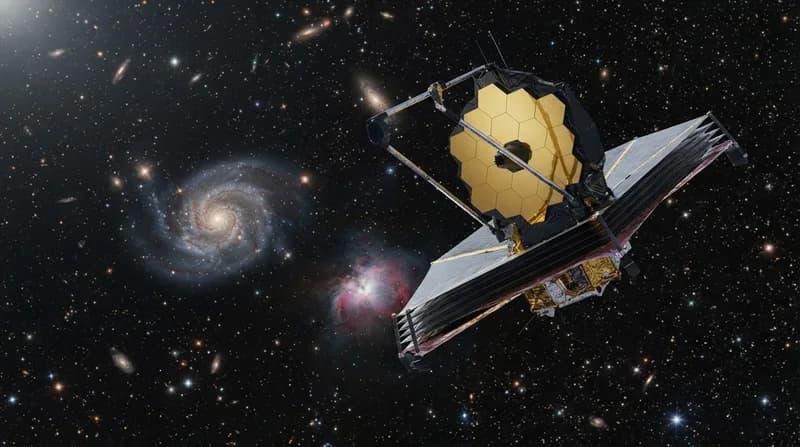
The JWST observation was a monumental technical achievement, representing the first time a stellar occultation was specifically predicted and executed using the space telescope. The precision required was immense, necessitating synchronized data regarding Chariklo’s orbital path, the exact position of the distant star (facilitated by the ESA’s Gaia mission), and the real-time trajectory of the JWST as it navigates its orbit around the L2 Lagrange point. Because Chariklo was moving at a slow relative speed of just 2.5 kilometers per second during the event, the team was able to extract unusually granular spatial data, turning a simple shadow into a roadmap of planetary evolution.
Implications for Solar System Models
The realization that Chariklo’s ring system undergoes noticeable changes on a multi-year timescale has forced a rethink of how small celestial bodies hold onto their material. Previously, such systems were viewed as either transient remnants of collisions or stable, long-lived structures. The new data suggests a middle ground: an environment where particles are in constant flux, potentially influenced by complex gravitational or collisional mechanisms that remain a mystery.
- Object Size: Approximately 250 kilometers in diameter.
- Location: Between Saturn and Uranus, 17 AU from the Sun.
- Key Finding: Inner ring opacity increased; outer ring opacity decreased within a few years.
- Observation Method: Stellar occultation using JWST backend sensors.
This discovery does more than just profile a single, obscure object; it provides a new template for understanding the life cycles of ring systems throughout the solar system. By confirming that these features are not necessarily permanent, astronomers have opened a new window into the physical processes that govern the architecture of our cosmic neighborhood. The mystery of what specifically drives these density shifts remains, but the hunt is now on to identify the forces causing such rapid, large-scale structural reconfigurations in the deep reaches of space.