Unveiling the Violent Nature of Planetary Evolution
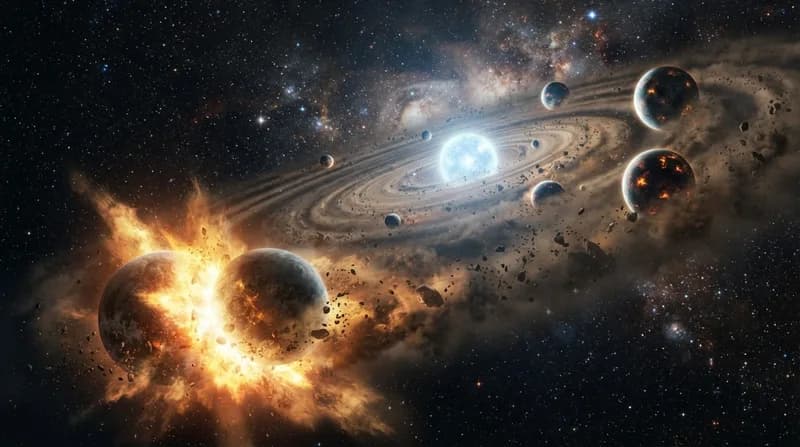
In a groundbreaking study published in The Astrophysical Journal, researchers utilizing the James Webb Space Telescope (JWST) have gained unprecedented insight into the chaotic and destructive events that define the infancy of solar systems. By examining 21 rare, high-energy systems labeled as extreme debris disks, astronomers have identified signature traces of cataclysmic collisions between planetary embryos. These observations serve as a cosmic archaeological record, reflecting the same violent mechanisms that scientists believe formed our own Moon billions of years ago.
While standard debris disks are common, the extreme variety is elusive, appearing in only about 1% of young stars. These systems are characterized by a surplus of warm, fine-grained dust situated in the precise orbital regions where rocky terrestrial planets typically form. By leveraging the mid-infrared sensitivity of the Webb telescope, the research team was able to categorize these disks by their chemical composition, effectively mapping the intensity of the impacts occurring light-years away.
Silica-Rich Disks: The Aftermath of Mars-Sized Impacts
The study highlights a distinct subset of extreme debris disks categorized as silica-rich, a composition associated with volcanic materials like obsidian. These systems appear to be the remnants of the most violent events imaginable—high-energy collisions between bodies comparable in size to Mars. The presence of silica suggests that these impacts were sufficiently energetic to vaporize massive quantities of rock, which then condensed into the fine dust particles detected by Webb.
These silica-rich environments have been observed exclusively around stars younger than 300 million years. This tight temporal window aligns with theoretical models of our own solar system, where the Earth and the Moon were likely forged by a similar impact approximately 100 million years after the Sun’s birth. By studying these distant collisions, scientists are confirming that the violent “remodeling” of planetary systems is a universal, rather than exceptional, phase in cosmic evolution.
Silica-Poor Disks: Grazing Impacts and Orbital Chaos
In contrast to their high-energy counterparts, the majority of the observed systems are silica-poor, containing minerals similar to the green forsterite sands found on Hawaiian beaches. These systems appear to result from lower-energy events, such as grazing collisions between smaller, Moon-sized objects. Interestingly, these disks show significant variability in their infrared brightness, which scientists attribute to the rapid shifting of material and ongoing orbital instability in these developing systems.
The prevalence of these lower-energy events suggests a broader timeline for planetary system maturation. While the silica-rich impacts occur early and abruptly, silica-poor disks appear around stars of widely varying ages. This longevity suggests that orbital instability can trigger intermittent periods of destruction long after the initial formation of a system, potentially mirroring the Late Heavy Bombardment period in our own solar system's history, where shifting giant planets sent smaller bodies crashing into one another.
Why It Matters
- Contextualizing Earth's History: These findings validate the theory that the Moon resulted from a Mars-sized collision, providing a real-time analog for our own formation.
- Direct Observation: Because planetary embryos are too small to image directly, analyzing the chemical makeup of their debris is the only way to observe their activity.
- Probing Future Evolution: Understanding these collision phases helps astronomers predict how stable a young solar system is likely to become over billions of years.