A New Era for Particle Physics
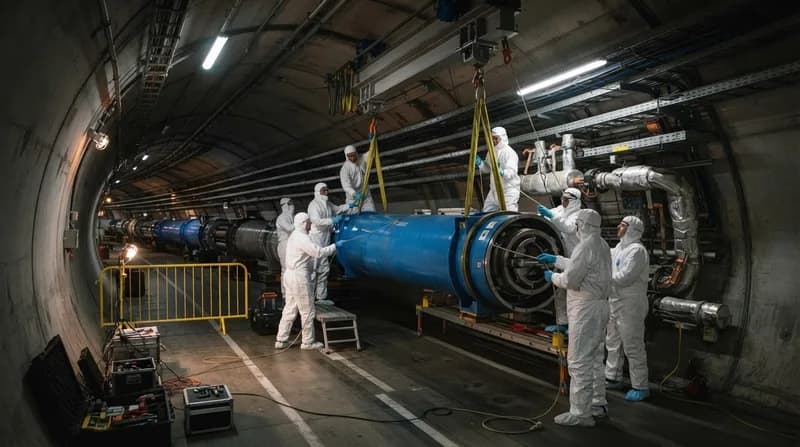
The Large Hadron Collider (LHC), the world's most sophisticated particle accelerator, has entered a period of significant physical transformation. Located deep beneath the Swiss-French border, the facility has officially begun its third long shutdown (LS3), a phase marked by the active disconnection of critical hardware. The objective is to replace the machine's existing "inner triplet" magnet arrays, paving the way for the High-Luminosity LHC (HiLumi LHC) project. This endeavor aims to fundamentally increase the number of particle collisions, granting researchers unprecedented access to data regarding the building blocks of the universe.
For nearly twenty years, the current magnets have served as the backbone of the LHC, focusing particle beams with pinpoint accuracy before they collide within the facility's massive detectors. As part of this current maintenance cycle, teams are now removing 28 superconducting magnets that have been in operation since the collider’s construction phase between 2005 and 2007. This handover represents a major milestone in engineering, as the facility pivots toward a significantly more powerful operational state.
The Technology Behind the Upgrade
The primary innovation driving this upgrade is the shift from niobium-titanium superconducting coils to advanced niobium-tin coils. While the older magnets served their purpose admirably, they are reaching the physical limits of their capability. The new generation of magnets will be capable of generating magnetic fields reaching 11.3 tesla—an increase of approximately 40% compared to the outgoing hardware. This leap in magnetic field strength is essential for the "squeezing" of particle beams into tighter streams, which drastically improves the probability of successful high-energy collisions within the ATLAS and CMS experiments.
The logistics of the project are substantial. The upgrade process involves the installation of 16 complex cryostats and 28 new cryo-assemblies. The integration of this hardware is expected to ramp up in the coming years, with the first of the new quadrupole magnets projected to arrive in the tunnel by early 2029. This effort is not merely a replacement of old parts, but a comprehensive redesign of the beam-focusing infrastructure designed to push the boundaries of what is observable in quantum physics.
Why It Matters
- Increased Data Throughput: Higher luminosity means a higher volume of collisions, providing physicists with the massive datasets required to identify rare phenomena and test the edges of the Standard Model.
- Advanced Materials: The adoption of niobium-tin superconductors showcases a move toward more resilient, high-field magnetic materials that can operate under extreme cryogenic conditions.
- Strategic Focus: By concentrating these upgrades on the ATLAS and CMS experiment zones, CERN is optimizing its resources to maximize the scientific output of its most prominent discovery-focused experiments.
Outlook and Implications
While the ALICE and LHCb experiments will retain their existing inner triplet magnets due to their differing research goals, they are still set to benefit from the general increase in the machine's luminosity. The transition from legacy components to these high-powered successors marks a transition in the maturity of the LHC. By the time the installation is complete, CERN will possess a machine more capable than ever of exploring the fundamental mysteries of matter, energy, and the origins of the universe. This hardware evolution signals that the peak of particle physics research is likely still ahead, enabled by bold leaps in superconducting engineering.