A New Frontier in Quantum Logic
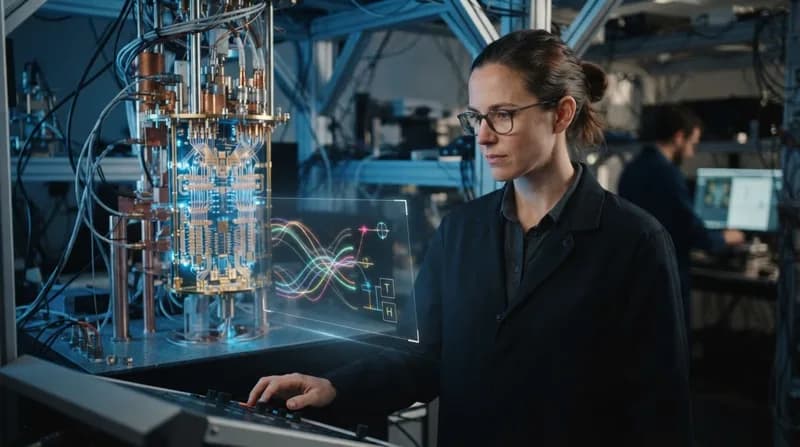
In a significant leap for computational physics, a collaborative team of scientists from the University of Chicago, Harvard, Stony Brook University, and Quantinuum has achieved a milestone that could fundamentally alter the trajectory of quantum hardware. The researchers successfully utilized non-Abelian anyons—exotic, quasiparticle-like structures—to perform a full, universal set of operations on the Quantinuum H2 trapped-ion processor. This achievement marks the first time these complex objects have been proven capable of supporting any arbitrary quantum algorithm, moving them from a theoretical curiosity to a viable architecture for future machines.
The experiment relied on 54 entangled qubits to create the required topological states. Unlike traditional qubits, which are prone to environmental noise, non-Abelian anyons store information globally across multiple entangled qubits. This configuration inherently protects data from the localized disturbances that plague standard quantum systems. By manipulating these structures through precise movements—known as braiding—and subsequent fusion measurements, the team successfully demonstrated the essential gate set required for universal quantum computing.
The End of Costly Distillation?
One of the most persistent hurdles in building fault-tolerant quantum computers is the phenomenon of decoherence. Currently, to keep errors in check, engineers use “magic state distillation,” a resource-intensive process that consumes a significant portion of a system’s available qubits. This bottleneck represents a primary barrier to scaling quantum systems to a practical size.
The breakthrough lies in the ability of non-Abelian anyons to bypass this entire process. By using topological operations to create these magic states directly, researchers have identified a path toward fault-tolerant computing that is exponentially more efficient. This suggests that the “dark horse” approach of non-Abelian physics might offer a more streamlined route to reliable, large-scale machines than the standard error-correction frameworks that dominate current industry research.
Why It Matters
- Universal Capability: Proves that exotic quantum particles can run any algorithm, not just specialized, narrow-scope tasks.
- Efficiency Gains: Demonstrates a theoretical pathway to avoid "magic state distillation," which is currently a massive drain on quantum processor resources.
- Fault Tolerance: Shifts the focus toward hardware that is naturally resilient to errors, rather than relying solely on software-heavy error-correction layers.
- Hardware Integration: Confirms that existing trapped-ion hardware (like Quantinuum's H2) is now sophisticated enough to host and manipulate these complex topological codes.
The Role of Fusion in Computation
While previous experiments conducted in 2024 proved that non-Abelian anyons could be created, they relied solely on braiding, which proved insufficient to perform universal computation. The recent breakthrough was made possible by incorporating "fusion," a process where two anyons are brought together, and their combined quantum state is measured. This combination of braiding to manipulate internal states and fusion to perform readout operations allowed the team to execute complex entangling gates that were previously inaccessible.
By encoding information into “topological qutrits”—which store three levels of quantum information—the team demonstrated that this non-Abelian framework is not just a theoretical model, but a functional operational system. As the team looks toward the future, the integration of active error correction into these non-Abelian setups will be the critical next step in moving from a laboratory proof-of-concept to the development of robust, fault-tolerant quantum processors.