Peering Into the Heart of Matter
In a major breakthrough for high-energy physics, researchers working with the ALICE experiment at CERN's Large Hadron Collider have achieved an unprecedented level of clarity when observing the subatomic landscape. By utilizing a sophisticated technique to measure incoherent J/ψ (pronounced "JAY-sigh") photonuclear production, the team has successfully mapped the behavior of gluons—the subatomic particles responsible for binding quarks together—with spatial resolutions as fine as one-quarter the size of a proton.
This study, which involved international collaboration and was spearheaded in part by University of Kansas physicist Daniel Tapia Takaki, moves beyond previous research that only offered averaged views of gluon distributions. By tracking both interaction energy and momentum transfer, the researchers acted as if they were using a high-powered microscope to zoom into the internal architecture of atomic nuclei, revealing that gluons exhibit complex, collective behaviors that were previously obscured by the limitations of older observational methods.
The Role of Gluons and Nuclear Structure
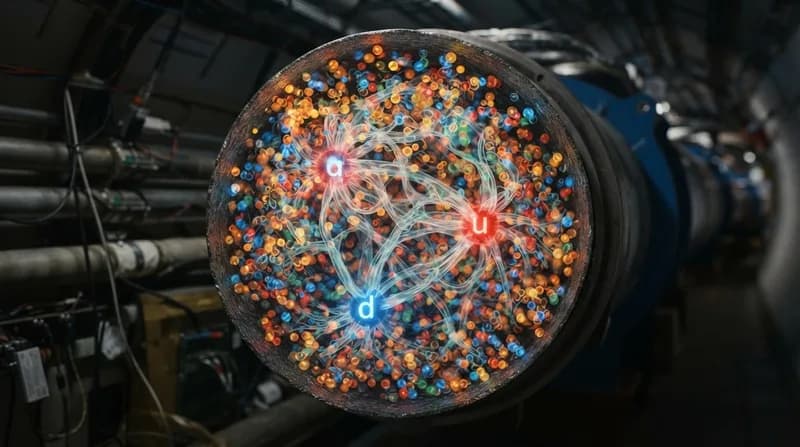
While quarks are often identified as the primary building blocks of matter, they account for only a small fraction of the mass in the visible universe. The vast majority of mass—whether in the human body or the core of a star—is derived from the energy carried by gluons and the strong force that binds particles together. Consequently, understanding how these gluons are distributed is not merely an exercise in abstract theory; it is fundamental to understanding the origin of mass itself.
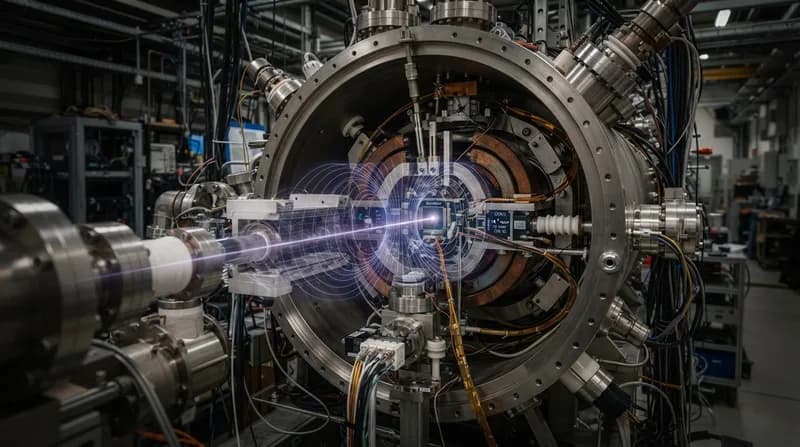
In this experiment, the team leveraged the intense electromagnetic fields generated when lead nuclei pass close to one another without a direct collision. These fields act as high-energy photon beams. When these photons strike another nucleus, they produce J/ψ particles, which serve as highly sensitive probes of the local gluon environment. By adjusting the momentum transfer, the researchers effectively changed the focus of their "gluon microscope," allowing them to probe structures at scales as small as 0.2 femtometers.
Challenging the 'Nuclear Shadowing' Theory
The findings have created significant ripples in the physics community by challenging the conventional "nuclear shadowing" model. For years, scientists have used this model to explain the behavior of gluons, comparing them to layers of clouds that block light, where overlapping gluons obscure one another and reduce the probability of specific particle production events.
However, the new data reveals a notable drop in J/ψ production at the smallest spatial scales, a phenomenon that standard shadowing theories struggle to explain. Instead, the experimental results align with the concept of "gluon saturation." Predicted by quantum chromodynamics, this theory posits that when gluons become sufficiently crowded, they begin to interact with one another so intensely that they reach a state of equilibrium, limiting the total number of gluons that can exist in a specific region. This discovery not only provides a high-resolution map of the nucleus but also offers a critical test for modern theories governing the strong force.
Why it Matters
- Origin of Mass: Identifying how gluons organize themselves helps physicists understand how the bulk of visible matter's mass is generated.
- High-Resolution Mapping: The ability to probe structures as small as one-quarter of a proton represents a massive leap in experimental precision.
- Theory Validation: The findings provide strong evidence for the existence of "gluon saturation," a complex state of matter that has been a theoretical prediction for decades.