1. Navigating the Milky Way and the Teapot
Between September 14 and 20, the night sky provides a perfect opportunity for amateur astronomers to sharpen their orientation skills. Shortly after sunset, observers looking toward the southern horizon will find the Moon acting as a celestial guide. As it traverses the sky, the Moon will drift past Antares, the vivid, reddish-hued star that serves as the heart of the Scorpius constellation.
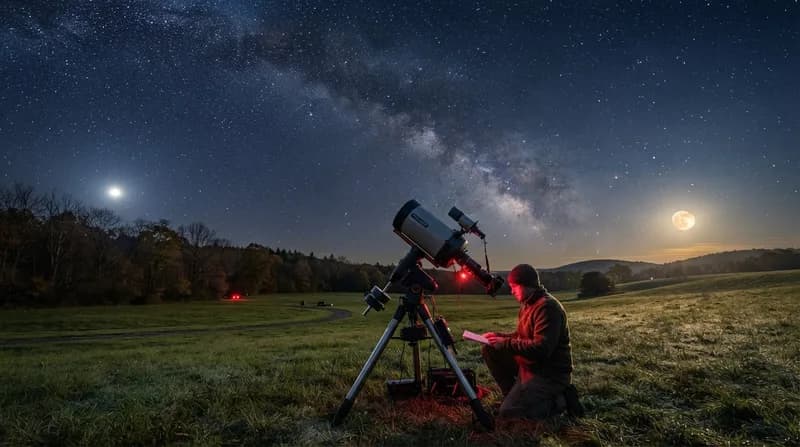
Nearby, the stars of Sagittarius form the unmistakable shape of a Teapot, complete with a handle, lid, and spout. For those fortunate enough to be in an area with minimal light pollution, a faint, ethereal band appears to rise from the Teapot’s spout like steam. This hazy glow is the densest region of the Milky Way, offering a breathtaking glimpse into the heart of our own galaxy.
2. Venus at Peak Brilliance
September 18 marks a major highlight for planetary observers as Venus hits its peak brightness for its current evening visibility cycle. Positioned low in the western sky, this intense, glowing beacon will easily outshine any star in the vicinity shortly after sunset. Given its proximity to the horizon, the planet will be most visible to those with an unobstructed view of the western skyline before it dips out of sight.
3. The September Equinox
The astronomical transition of the seasons arrives on September 22. This date signals the September equinox, a moment when the Sun sits directly above Earth's equator. During this period, the duration of day and night becomes nearly equal for most of the planet. It serves as the official beginning of autumn in the Northern Hemisphere, while signaling the onset of spring for the Southern Hemisphere.
4. The Harvest Moon and Planetary Neighbors
As the month draws to a close on September 26, the Harvest Moon will command attention as it rises in the eastern sky. This full moon will be accompanied by two planetary companions: Saturn and Neptune. Saturn will be bright enough to be viewed with the naked eye, appearing as a steady, luminous point near the lunar disc.
Neptune, however, remains elusive due to its distance and low magnitude of approximately 8. While it completes a celestial triangle with the Moon and Saturn, spotting this ice giant will require the use of binoculars or a telescope. Clear, dark skies are recommended to track down this distant world alongside its more prominent neighbors.
Why It Matters
Events like these serve as a vital bridge between scientific research and the public. By utilizing simple observation techniques—or participating in events like International Observe the Moon Night on September 19—the public can engage directly with the mechanics of the solar system. These monthly highlights emphasize the accessibility of astronomy, reminding us that with just a clear horizon and perhaps a pair of binoculars, the complexities of space become a shared human experience.