A New Chapter for Southeast Asian Manufacturing
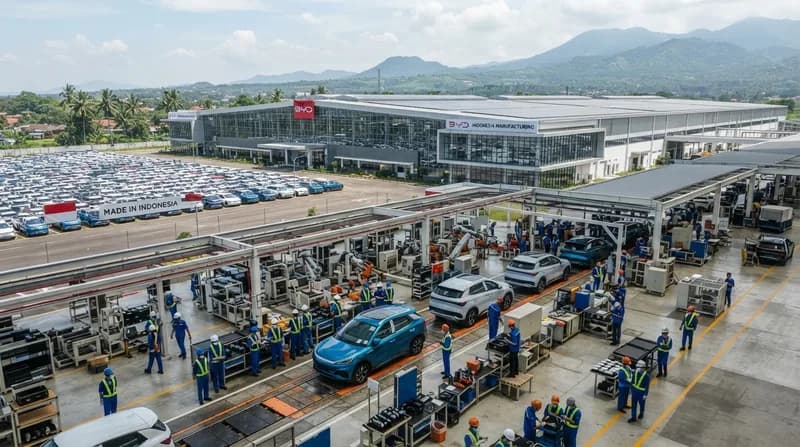
BYD has officially commenced operations at its cutting-edge manufacturing facility located in the Subang Smartpolitan Industrial Park, West Java. This marks a significant milestone for the Chinese automotive giant, representing its third major production hub in Southeast Asia, following previous expansions in Thailand and Cambodia. The sprawling 126-hectare site is poised to become a central pillar of BYD’s regional strategy, designed with a robust annual capacity of 150,000 units. Currently, the plant employs 5,000 workers, though BYD has indicated that headcount could eventually climb to over 20,000 as production scales.
The facility is fully integrated, housing four critical manufacturing streams: stamping, welding, painting, and assembly. This vertical integration is a hallmark of the company’s manufacturing philosophy, allowing for tighter quality control and faster turnaround times. The first vehicle to roll off the assembly line was the M6 DM, a versatile plug-in hybrid MPV boasting an impressive 110-kilometre range in pure electric mode. The facility is also tasked with the production of the Atto 1, known internationally as the Dolphin Surf, which held the title of Indonesia’s best-selling electric vehicle in 2025 with over 22,500 units registered.
Strategic Shift and Market Implications
In a bold move to align with Indonesia’s government-mandated local content requirements, BYD has officially ceased all vehicle imports into the country. This decision signals a decisive pivot away from its previous import-heavy model, which saw the company leverage government tax incentives to import nearly 92,000 units between 2024 and 2025. By shifting focus exclusively to local production, the company aims to meet strict domestic requirements before the 2027 deadline, ensuring long-term sustainability within the Indonesian market.
The policy shift means that popular models like the Dolphin, Atto 3, Seal, and Sealion 7 may be effectively phased out as the company reallocates resources toward locally built alternatives. Looking ahead, the company plans to introduce local production of the M6 EV and the premium Denza D9, the latter of which will be offered exclusively as an all-electric variant to cater to the specific demands of the Indonesian landscape. Furthermore, preliminary interest in the Racco electric kei car appears strong, suggesting that the local lineup will continue to evolve rapidly.
Why It Matters
- Supply Chain Sovereignty: By shifting to local production, BYD reduces vulnerability to import duty fluctuations and logistics bottlenecks.
- Economic Growth: The expansion supports Indonesia’s broader goal of becoming a regional EV hub, with massive job creation potential in the West Java region.
- Market Maturation: With over 70,000 EV sales in the first half of 2026 alone, the local manufacturing shift mirrors the country’s accelerating adoption of electrified transport.
- Retail Expansion: To support this production surge, BYD plans to double its network of sales outlets from the current 100 locations to over 200 by next year.
As the Indonesian government continues to nurture its domestic EV ecosystem, BYD's aggressive investment serves as a clear indication that the region is no longer just a destination for exports, but a critical manufacturing engine for the global automotive transition.