ScienceTechnical Deep Dive

Ancient 'Dripduction' Revealed: How Water Fueled Volcanoes 3 Billion Years Ago

Published
EElectricBuzz Editorial Team
Ancient 'Dripduction' Revealed: How Water Fueled Volcanoes 3 Billion Years Ago
3 min read503 wordsElectricBuzz Editorial Team

The Gist

New geological research suggests the young Earth was far more dynamic than previously thought, using a process called 'dripduction' to recycle water into the mantle.

Rewriting the Geological Record

For decades, geologists have operated under the assumption that the complex recycling of water from the Earth's surface into its deep interior—a cornerstone of modern plate tectonics—is a relatively recent innovation in our planet's history. However, a groundbreaking study led by geochemist Dr. Eric Vandenburg of Adelaide University has challenged this timeline. By analyzing ancient volcanic rocks from Western Australia's Pilbara Craton, researchers have uncovered evidence that Earth was already circulating water deep into its mantle as early as 3.1 billion years ago, a time when the planet's surface was significantly hotter and vastly different from the world we inhabit today.

The Mystery of Dripduction

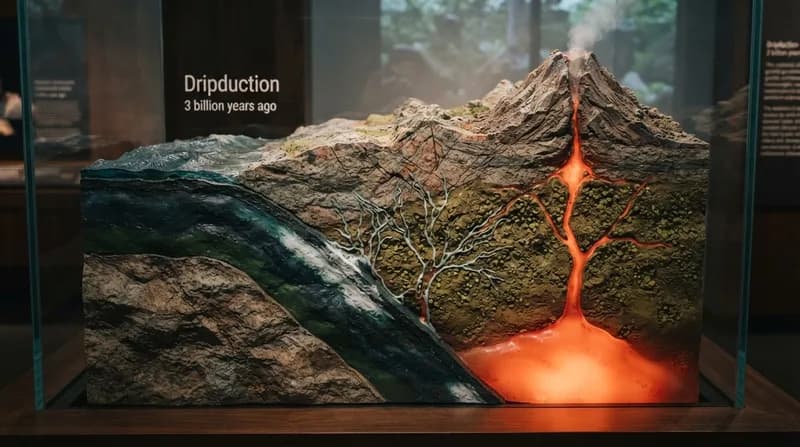
Because the early Earth was too hot for modern, plate-driven subduction, scientists have long puzzled over how water could have reached the mantle. The research team proposes a mechanism dubbed "dripduction." In this scenario, dense and water-saturated sections of the planet's cooling outer crust did not slide neatly beneath one another like modern tectonic plates. Instead, these heavy, water-rich segments of the crust would sag and eventually drip downward into the scorching heat of the mantle.

As these cold "drips" descended, they released their trapped water into the mantle’s depths. This influx of water acted as a catalyst, triggering the creation of magma. This magma would then rise toward the surface, fueling volcanic eruptions that mirrored the characteristics of the modern "Ring of Fire" volcanoes. This discovery proves that even in its infancy, the Earth possessed the complex internal machinery necessary to circulate materials between the surface and the deep interior, a process that is essential for continent formation and the potential development of life.

Why It Matters

  • Advancing Earth's Timeline: The discovery pushes back the window for when Earth began actively recycling materials between its surface and core by hundreds of millions of years.
  • Understanding Volcanism: By identifying "dripduction," scientists have a clearer understanding of how ancient volcanoes functioned without the aid of modern plate tectonics.
  • Evolution of Habitability: Investigating how water moved through the crust helps researchers understand the geological conditions that shaped the early planet and fostered an environment suitable for life.
  • Geological Preservation: The Pilbara Craton serves as a vital laboratory, offering a rare window into the chemistry of a world that existed billions of years before the modern geological era.

Implications for Future Research

The study, published in Nature Communications, represents a massive collaborative effort involving experts from institutions across Australia, the UK, and Germany. By decoding the chemical signatures locked within these 3.1-billion-year-old rocks, the team has turned a static snapshot of the past into a dynamic narrative of a young, active planet. This research suggests that Earth was not a dormant, monolithic rock in its early stages but rather a complex system already engaging in the deep-cycle processes that define its current geology. As scientists continue to analyze these rare samples, the findings promise to refine our understanding of how our continents grew and how the planet matured into the vibrant, shifting landscape we recognize today.

The 5 Best Over-Ear ANC Headphones of 2026, Tested & Ranked
Editor's Pick Guide
92/100
Tech & Gadgets12 min read

The 5 Best Over-Ear ANC Headphones of 2026, Tested & Ranked

We locked five over-ear ANC picks for 2026 — Sony WH-1000XM6, Bose QuietComfort Ultra 2, Soundcore Space One, Sennheiser Momentum 5, and Apple AirPods Max 2 — then stress-tested them on lab metrics, long-term owner truth, and live street prices.

Related Stories

Semantically matched articles, ranked by topic overlap and freshness.

NASA's Roman Space Telescope Set for Two Decades of Cosmic Discovery
Science

NASA's Roman Space Telescope Set for Two Decades of Cosmic Discovery

Thanks to exceptional launch precision and significant fuel savings, the Nancy Grace Roman Space Telescope is poised to more than double its mission life, potentially operating for over 22 years.

Unlocking Predictive Markers: How B Cells Could Forecast Immunotherapy-Induced Colitis
Science

Unlocking Predictive Markers: How B Cells Could Forecast Immunotherapy-Induced Colitis

New research from MD Anderson Cancer Center suggests that B cell activity acts as a crucial early-warning system for identifying patients at risk of developing severe colitis during cancer treatment.

Could a Tiny Brain Protein Be the Master Switch for Aging?
Science

Could a Tiny Brain Protein Be the Master Switch for Aging?

Researchers have identified that declining levels of a brain protein called Menin may drive systemic aging, offering a potential new target for age-related health interventions.

Challenging Einstein: Scientists Pioneer Gravity Tests Using Exotic Muonium Atoms
Science

Challenging Einstein: Scientists Pioneer Gravity Tests Using Exotic Muonium Atoms

Researchers at ETH Zurich have developed a method to create controlled beams of muonium, potentially enabling the first-ever gravitational tests on second-generation particles.

Unlocking the Narrative: AI System Transforms Physician Notes into Actionable Medical Data
Science

Unlocking the Narrative: AI System Transforms Physician Notes into Actionable Medical Data

A groundbreaking study reveals how a new AI system can parse clinical prose at scale, converting hidden patient insights into verifiable, computer-readable data.

Caltech’s Femtosecond Breakthrough: Steering Light with Light
Science

Caltech’s Femtosecond Breakthrough: Steering Light with Light

Researchers have engineered a nanoscale silicon metasurface capable of redirecting light beams in just 74 quadrillionths of a second, shattering traditional speed barriers in photonic computing.

Beyond the Starch: Why Black and Green Rice Are Emerging as Metabolic Superfoods
Science

Beyond the Starch: Why Black and Green Rice Are Emerging as Metabolic Superfoods

New research from Hokkaido University reveals that pigmented rice varieties contain unique, beneficial fats that could revolutionize dietary approaches to blood sugar management.

Biological Breakthrough: Scientists 3D-Print a Functional Human Gut-on-a-Chip
Science

Biological Breakthrough: Scientists 3D-Print a Functional Human Gut-on-a-Chip

Researchers at Lawrence Livermore National Laboratory have successfully replicated the complex 3D architecture of the human small intestine on a compact, microfluidic device.