Revolutionizing Nonlinear Optics with Deep Learning
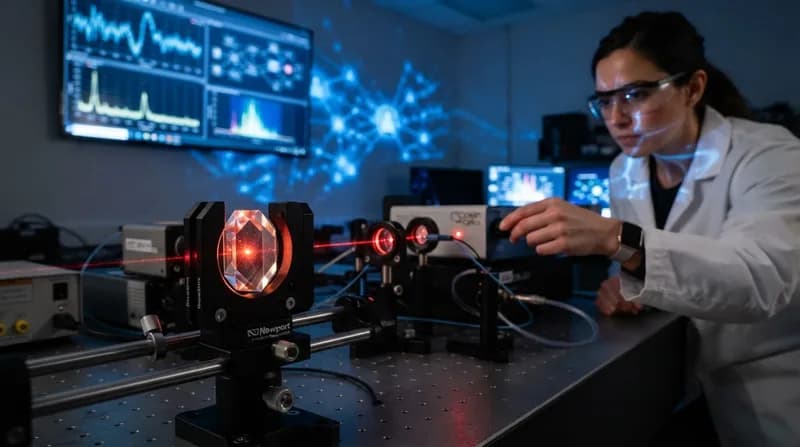
A collaborative team of researchers from Stanford University, UCLA, and the SLAC National Accelerator Laboratory has unveiled a new artificial intelligence system capable of simulating complex laser interactions with unprecedented speed. By utilizing deep learning architectures, the team has achieved a 250x acceleration in predictive modeling, effectively removing a major computational bottleneck that has long hindered the field of second-order nonlinear optics, or chi-2 processes.
These light-matter interactions, which occur as photons travel through specialized crystals, are essential for frequency conversion and pulse shaping in high-intensity laser systems. Traditionally, modeling these phenomena requires solving the nonlinear Schrödinger equation using the split-step Fourier method. This legacy approach is computationally expensive, often consuming 95 percent of the processing time in laser research simulations. The new AI-driven method, however, bypasses these repetitive, time-intensive calculations by processing compressed representations of light's frequency characteristics, achieving results in mere milliseconds without sacrificing accuracy.
Technical Architecture and Methodology
The core of this breakthrough is a recurrent neural network based on Long Short-Term Memory (LSTM) architecture. Unlike traditional numerical solvers that toggle back and forth between time and frequency domains, the researchers designed this neural network to operate entirely within a compressed frequency space. This architectural choice is what allows the system to shed the weight of conventional math, drastically reducing the latency of the simulation.
To validate the model, the team tested it against noncollinear sum frequency generation (SFG), a process involving three interconnected light fields evolving simultaneously within a crystal. The AI demonstrated remarkable robustness, maintaining high fidelity across a variety of pulse shapes, including those with significant phase variations or gaps in their frequency spectra. Because the system was trained to understand the interdependencies of these light fields, it accurately predicts multiple output streams simultaneously, proving it has learned the underlying physics rather than merely memorizing individual data points.
Why It Matters: The Path to Digital Twins
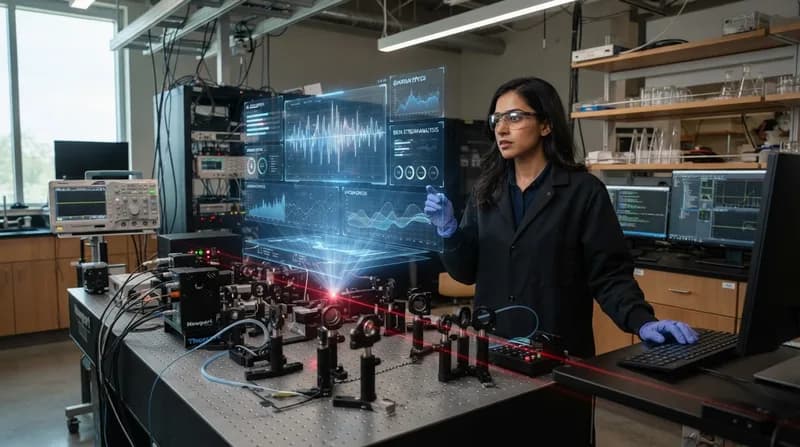
The implications of this research extend far beyond academic computation. The team envisions integrating these neural networks directly into large-scale experimental facilities, such as the Linac Coherent Light Source (LCLS-II) at SLAC. By enabling the creation of 'digital twins'—high-fidelity virtual replicas of experimental hardware—scientists could soon monitor laser performance in real-time.
This real-time feedback loop would allow for adaptive laser control, where the system autonomously adjusts settings to compensate for environmental variables or equipment drift. This transition from static, offline simulations to dynamic, predictive control could fundamentally change how researchers generate and manipulate intense X-ray pulses, ultimately accelerating discovery in fields ranging from materials science to molecular biology.
Key Implications for Research Facilities
- Computational Efficiency: Reducing simulation time from hours to milliseconds allows for iterative design and rapid prototyping of laser systems.
- Real-Time Optimization: Modular neural networks can be deployed to predict system behavior while experiments are actively running, enabling on-the-fly tuning.
- Scalability: By utilizing GPU-accelerated environments, facilities can perform high-throughput simulations that were previously considered impossible due to hardware limitations.