The Submerged Threat of the UC-30
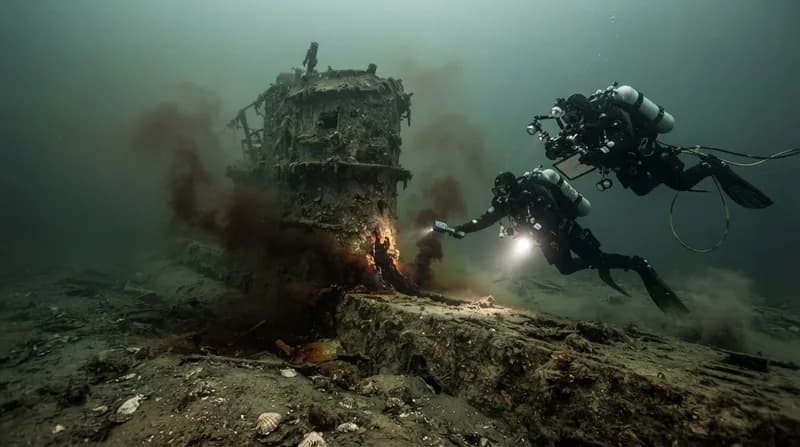
In April 1917, the German submarine UC-30 met a tragic end near the Danish coast. Following engine failures that forced it to abort a mission to Ireland, the vessel struck a British mine, claiming the lives of all 27 crew members and sending a cargo of 18 mines and six torpedoes to the seafloor. For nearly a century, the wreck sat undisturbed until its 2016 discovery by diver Gert Normann Andersen. Today, it serves as a stark reminder that the history of the North Sea is not just one of naval combat, but of long-term environmental contamination.
Recent research led by Katrine Juul Andresen of Aarhus University, as part of the extensive NorthSeaWrecks project, has confirmed that the vessel is actively leaking TNT. Through collaboration with navy divers, researchers collected sediment, water, and local marine life—specifically starfish and mussels—around the wreck. The results were conclusive: explosive chemical compounds are leaching into the surrounding ecosystem. As the metal hull continues to corrode, the risk of greater exposure grows, turning these historical artifacts into persistent, localized pollution hazards.
The Scale of the Maritime Challenge
The issue of underwater munitions is not isolated to a single submarine. Danish waters alone contain an estimated 10,127 shipwrecks, with roughly 15 percent dating back to the two World Wars. This massive number of submerged wrecks presents a complex puzzle for environmental authorities, who are under pressure to comply with international standards like the EU Water Framework Directive. The legacy of these conflicts has left a sprawling, metallic graveyard that poses an increasing threat as time and saltwater compromise the integrity of the munitions stored within.
Addressing this pollution is fraught with logistical and safety concerns. Simply detonating these explosives underwater is often ruled out, as the shockwaves and subsequent dispersion of chemicals can cause more ecological damage than leaving the items in situ. Furthermore, recovery operations are incredibly expensive and technically demanding. As scientists look for solutions, they emphasize that a "one-size-fits-all" approach is ineffective, as the risk posed by a wreck often depends on its depth, the surrounding currents, and whether the hull remains buried under protective layers of sand.
Innovating Toward Safer Remediation
To mitigate these risks, the international REMARCO project is investigating new, non-invasive technologies. Among the most promising tools are advanced seafloor-crawling robots designed to map and monitor the condition of munitions in real-time. These robotic systems offer a level of precision that traditional diving cannot achieve, allowing researchers to gather data on the degradation of shells and torpedoes without disturbing the seabed or triggering unintended releases of toxic substances.
Looking to the future, the goal is to develop robotic systems capable of more than just observation. Researchers envision units that can cautiously extract hazardous materials from the seabed for neutralized disposal on land. While not every wreck requires intervention—especially those effectively shielded by natural sediment—the rise of these specialized technologies represents a vital shift in maritime environmental policy. By prioritizing the most hazardous sites, authorities hope to neutralize the toxic legacy of the North Sea before the natural decay of these warships results in irreparable environmental consequences.