A Century-Old Archaeological Mystery
For over a hundred years, the archaeological record surrounding the burial sites at Abydos, Egypt, has hinted at a gruesome practice. When renowned archaeologist Flinders Petrie first excavated the royal tombs of Egypt’s First Dynasty in the 1920s, he was struck by an unusual sight: hundreds of subsidiary burials surrounding the kings' primary chambers. These graves, filled with mid-level officials and artisans, led Petrie to suspect that these individuals had been sacrificed to serve their masters in the afterlife. However, the lack of definitive physical evidence for violent death left the theory as an intriguing, albeit unproven, speculation.
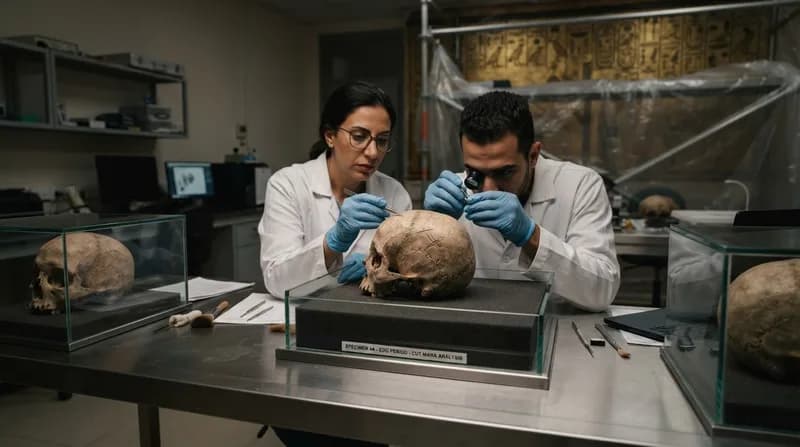
Now, a groundbreaking forensic study has finally brought this dark chapter of history to light. Dr. Roselyn Campbell of Purdue University has re-examined 46 skulls from the original Abydos excavation, currently housed in the Duckworth Collection at Cambridge University. By applying modern forensic techniques to these ancient remains, researchers have uncovered undeniable proof that many of these attendants did not die of natural causes, but were instead the victims of state-sanctioned violence.
Evidence of Perimortem Trauma
The forensic investigation revealed that 18 of the 46 skulls—approximately 39%—exhibited significant cranial trauma. Previously, early 20th-century investigators had dismissed these linear fractures as post-mortem damage or natural decay. However, modern analysis confirms these as perimortem injuries, meaning they occurred precisely at the time of death. The nature of these fractures is highly specific: they are consistent with impacts from broad, flat objects, ruling out common battlefield weaponry like maces, which typically leave depressed, circular fractures.
Furthermore, the researchers identified sharp-force trauma on several of the skulls, including a severe injury to an individual's eye socket. While accidental falls could technically cause linear fractures, the lack of corresponding skeletal trauma—such as broken limbs or ribs—strongly suggests that these injuries were intentionally inflicted. This supports the hypothesis that these individuals were executed, likely as part of a formal ritual intended to ensure the ruler had a household to attend to them in the afterlife.
The Cultural Context of Retainer Sacrifice
The practice of 'retainer sacrifice' is a phenomenon seen across various ancient cultures, serving as a visceral demonstration of a ruler's absolute power. Whether these individuals were forced into the afterlife or viewed it as a prestigious duty remains a subject of intense historical debate. The grave goods found alongside these remains—which include copper tools, ceramics, and ivory figurines—suggest that while they served the king, they were also individuals with specific roles and titles, ranging from artisans to administrative officials.
This study highlights the incredible power of revisiting 'legacy data' with modern scientific tools. By moving beyond the limitations of century-old analysis, scientists can now piece together the human stories behind the footnotes of history. While the majority of the original skeletal remains were reburied decades ago, this partial collection has provided a critical, chilling glimpse into the violent rituals that defined the dawn of Egyptian civilization.