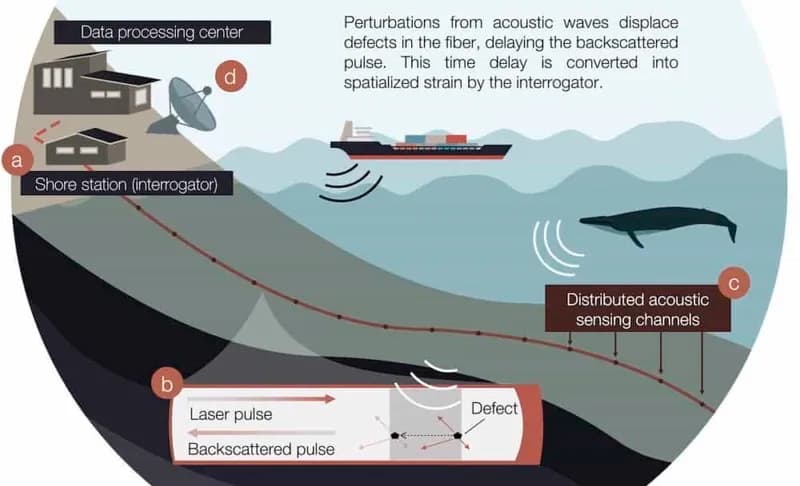
Researchers have discovered a breakthrough method for monitoring marine life by utilizing the vast network of undersea optical fibers already spanning the globe. By employing Distributed Acoustic Sensing (DAS) technology, scientists can now detect the physical motion of whales as they move through the water.
Monitoring Beyond Vocalization
Traditionally, tracking whales has relied heavily on acoustic monitoring, which requires the animals to be vocalizing. However, this new approach allows for the detection of 'silent' whales. The sensitive optical fibers can pick up the subtle pressure changes and vibrations caused by the displacement of water as these massive creatures swim near the cables.
This development could transform marine biology by providing a non-invasive, global tool for tracking migration patterns and behavior. Because the infrastructure is already in place, it offers a cost-effective alternative to deploying specialized hydrophones in remote oceanic regions.