In a groundbreaking advancement for synthetic biology, researchers at the University of California, San Diego, have engineered RNA polymerase to accurately transcribe an eight-letter genetic alphabet. Published in Nature Communications on September 2, 2026, this work demonstrates that the molecular machinery of life can read a genetic code far more complex than the four-letter system used by all known biology on Earth. The achievement effectively doubles the information capacity of the genetic code, opening the door to organisms and biological systems that can produce compounds and proteins not found in nature.
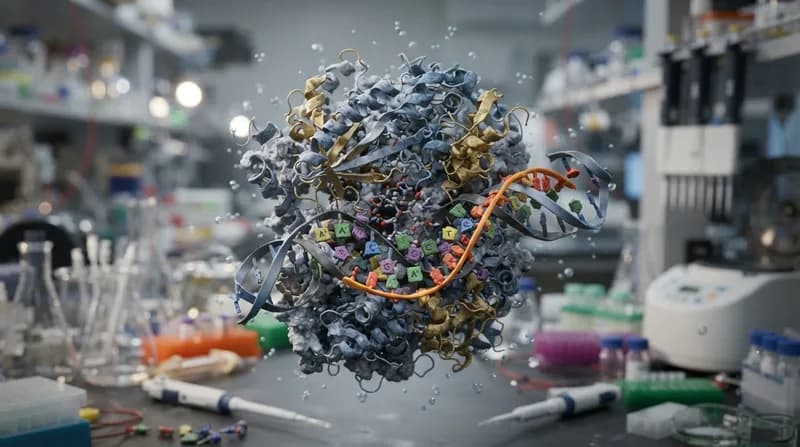
The research team, led by Professor Dong Wang at UC San Diego, utilized high-resolution cryo-electron microscopy to capture the enzyme from E. coli bacteria incorporating two synthetic base pairs. The high-resolution structural imaging revealed that RNA polymerase recognizes artificial letters using many of the same structural and biochemical signals as natural base pairs. This finding is significant because it suggests that the enzyme's recognition mechanisms are more flexible and generalizable than previously assumed, relying on a set of conserved structural motifs rather than strict hydrogen-bonding requirements.
Complementary findings published in the Proceedings of the National Academy of Sciences (PNAS) on August 12, 2026, further illuminated the versatility of this engineered system. A related study found that RNA polymerase can recognize synthetic base pairs even when they lack the hydrogen bonds normally required to hold DNA base pairs together. Instead of relying on these canonical bonds, the enzyme promotes catalysis through hydrophobic interactions. This mechanism allows the transcription of artificial genetic letters that would otherwise be structurally unstable, expanding the potential design space for synthetic nucleotides.

- Eight-letter alphabet: The system doubles nature's four-letter genetic code, incorporating two synthetic base pairs.
- Structural recognition: Cryo-EM imaging shows RNA polymerase uses similar recognition mechanisms for synthetic and natural bases.
Hydrophobic catalysis:The enzyme can transcribe synthetic bases lacking hydrogen bonds, relying instead on hydrophobic interactions.- Publication dates: The structural basis study appeared in Nature Communications (September 2, 2026), while the mechanism study appeared in PNAS (August 12, 2026).
- Lead researcher: Professor Dong Wang at UC San Diego led both studies.
This dual breakthrough provides the structural and mechanistic foundation for expanded genetic systems. By proving that RNA polymerase can transcribe an eight-letter alphabet, the research clears a major hurdle toward creating organisms with novel biological functions. The implications are vast, ranging from advanced diagnostic tools and new classes of therapeutics to entirely engineered biological systems capable of producing synthetic compounds. As the field moves forward, this work stands as a critical stepping stone toward a future where the genetic code is only limited by imagination, not by the constraints of natural evolution.
— Reported by the ElectricBuzz Science Desk