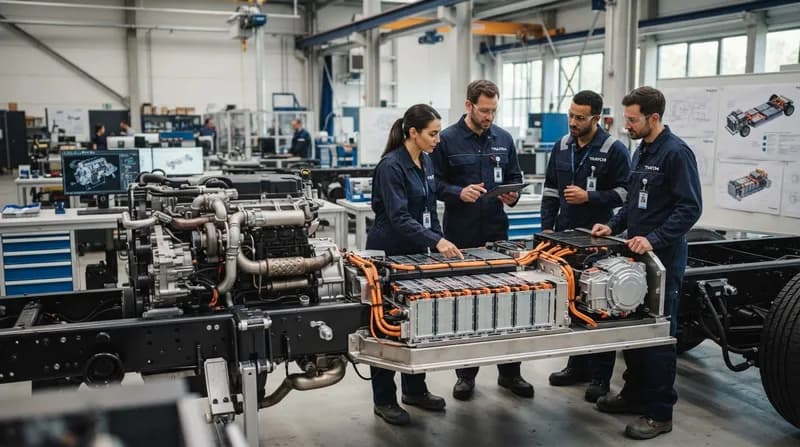
Shifting Strategies in Heavy-Duty Electrification
The Traton Group, which encompasses major heavy-duty automotive brands including Scania and MAN, is undergoing a significant strategic pivot regarding its battery technology roadmap. Niklas Klingenberg, the company’s R&D chief, recently confirmed that the organization is officially developing Lithium Iron Phosphate (LFP) battery technology. This marks a pivotal shift for Traton, which has historically relied almost exclusively on Nickel Manganese Cobalt (NMC) chemistry to power its electric commercial fleet.
Klingenberg, who has spent over two decades within the group, now oversees the centralized R&D function that consolidates battery development across all Traton brands. By centralizing these efforts, the group aims to capitalize on economies of scale, reduce overall investment costs, and accelerate the rollout of innovative charging solutions. The move toward LFP is largely seen as a necessary evolution to meet diverse customer needs and maintain competitiveness in an increasingly crowded global market.
The Push for Greater Operational Range
Traton’s recent engineering efforts have yielded significant performance improvements, with some current models achieving ranges of up to 720 kilometers. According to Klingenberg, this range capability is essential for commercial operators who require vehicles to handle extended, uninterrupted driving shifts—often exceeding four and a half hours—without the immediate availability of charging infrastructure. The goal is to provide enough reserve power to complete a full daily duty cycle, alleviating the 'range anxiety' that often plagues fleet electrification efforts.
While 720 kilometers represents a current milestone, the R&D team is actively investigating future use cases that may demand even higher energy capacities. By focusing on cross-brand platforms, Traton intends to remain flexible, ensuring that its hardware can scale alongside customer demand as the logistics sector continues to transition toward full electrification.
Addressing Global Competition and Technology Diversity
The rise of new competitors from Asia and the aggressive entry of international players like Tesla into the European market have prompted Traton to reconsider its development pace. Klingenberg emphasizes that the European ecosystem must 'level up' its collaborative efforts, drawing lessons from the tightly integrated supply chains and OEM ecosystems observed in China. This collaborative mindset is now central to how Traton approaches its 'Next Era' product lineup.
Why it Matters
- Strategic Diversification: Adopting LFP chemistry allows Traton to offer a wider range of battery price points and performance profiles, making EVs more accessible for various transport segments.
- Market Competitiveness: Increased pressure from new market entrants is forcing traditional European heavy-vehicle manufacturers to tighten their R&D cycles and improve operational efficiencies.
- Technological Pragmatism: While remaining committed to a battery-electric future, Traton continues to explore transitional technologies, such as range extenders and pantograph systems, to lower emissions in the immediate term while long-term infrastructure matures.
While hydrogen and battery-swapping technologies remain on the radar, Klingenberg maintains that they are not the primary focus for Traton. Instead, the company is doubling down on battery-electric vehicles as the superior long-term solution for total cost of ownership. By staying open to various technology paths while refining their core battery chemistry, Traton is positioning itself to remain a dominant force in the global shift toward zero-emission logistics.