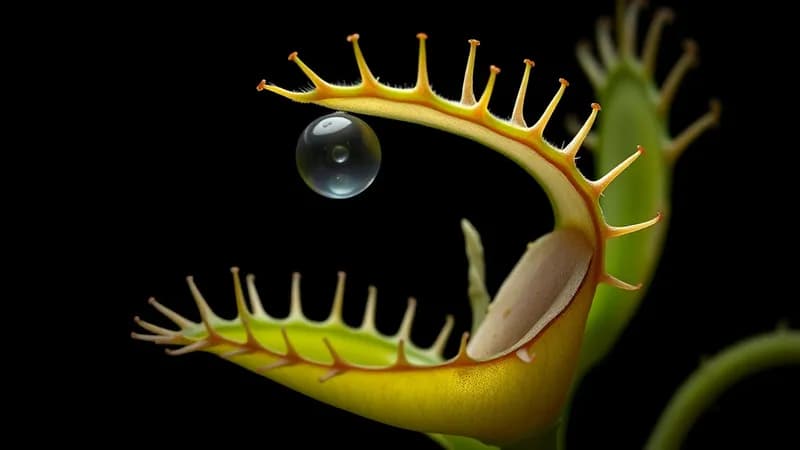
The Venus flytrap has long fascinated scientists with its ability to execute rapid movements without having a nervous system or muscles. Recent physics-based inquiries have sought to decode the exact mechanism behind this botanical speed, focusing on the release of elastic energy stored within the plant's leaves.
Elastic Instability and Snap-Buckling
Researchers have identified that the Venus flytrap utilizes a phenomenon known as 'snap-buckling.' This process involves the leaf lobes shifting from a convex to a concave shape almost instantly. This transition is triggered by sensory hairs that detect prey, causing a physiological change that releases accumulated mechanical tension.
Understanding these biological mechanisms provides valuable insights into the field of biomimicry. Engineers are increasingly looking at these natural 'actuators' to design soft robotics and smart materials that can react to environmental stimuli without the need for complex electronics or heavy power sources.