A New Era for Neural Interfacing
In a significant breakthrough for neuroscience and biomedical engineering, a multi-institutional research team has unveiled the microfluidic Axialtrode, or mAxialtrode. This innovative brain implant represents a departure from traditional, rigid electrode arrays, offering a far more versatile and less invasive approach to studying the intricate communication pathways of the mammalian brain. By consolidating multiple functions into a single, needle-thin fiber, the device promises to reshape how scientists approach neurological research and potential future therapies.
The mAxialtrode was developed through a collaborative effort involving the Technical University of Denmark (DTU), the University of Copenhagen, and University College London. Detailed in the journal Advanced Science, the technology is currently positioned as a high-precision research instrument. It allows investigators to observe and manipulate neural circuits across different layers of the brain with unprecedented accuracy, effectively bridging the gap between isolated data collection and complex, real-time physiological modulation.
Design and Technical Innovation
The primary advantage of the mAxialtrode lies in its physical construction, which prioritizes biocompatibility and multi-layered functionality. Conventional brain implants are often manufactured using rigid silicon, a material that can irritate surrounding neural tissue and trigger inflammatory responses over time. In contrast, the mAxialtrode is crafted from flexible, polymer-based optical fibers. This softness ensures that the implant moves in harmony with the brain tissue, significantly reducing the potential for trauma during and after the insertion process.
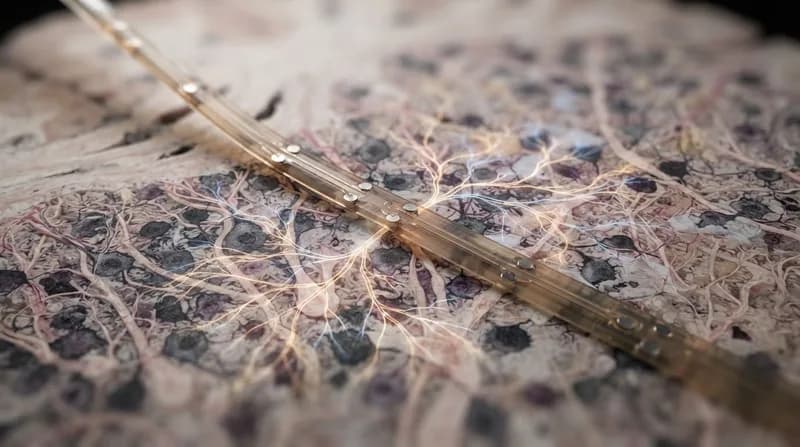
Measuring less than half a millimeter in diameter, the fiber is an engineering marvel. Its internal architecture features a central light-conducting core designed for optogenetic stimulation, surrounded by eight integrated microscopic channels. These channels serve as conduits for fluid delivery—enabling the precise injection of medication—and house ultra-thin metal wires that record electrical activity. This structural design allows for the targeting of multiple, distinct depths within the brain simultaneously, a feat that was previously difficult to achieve without utilizing multiple, invasive devices.
Implications for Future Clinical Care
While the current iteration of the mAxialtrode is primarily intended for laboratory research—specifically to better understand the mechanisms of epilepsy, decision-making, and memory—the implications for clinical medicine are profound. By providing a single point of entry for monitoring and intervention, the technology could eventually serve as a therapeutic tool for patients suffering from neurological disorders. The ability to deliver medication to a specific site while simultaneously applying targeted electrical or light-based stimulation could allow for personalized, responsive treatments that are far more effective than systemic drug delivery.
The research team has already demonstrated the viability of the device through in vivo testing in mice. During these experiments, the implant successfully enabled dual-wavelength light stimulation and electrical recording from the cerebral cortex and hippocampus. As the team moves toward patenting the technology and considering the pathway for human clinical trials, the mAxialtrode stands as a promising development in the ongoing effort to create sophisticated, low-impact interfaces between technology and the human nervous system.