The Illusion of the Horizon
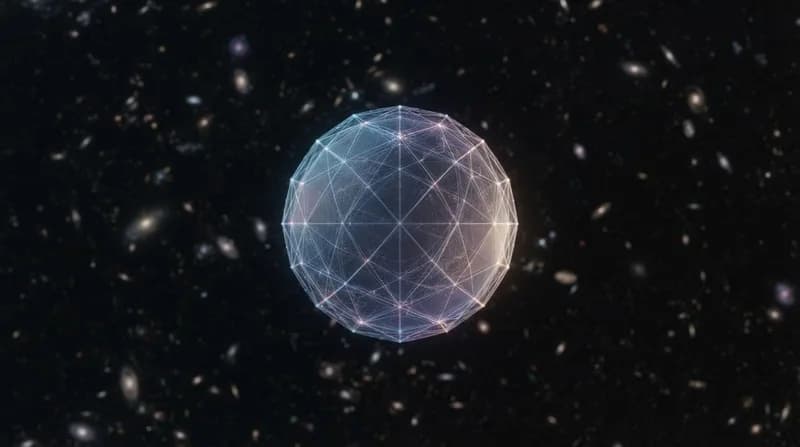
When we gaze into the night sky, it is tempting to imagine that the universe simply continues forever—a vast, uniform tapestry of stars, galaxies, and voids stretching out into eternity. However, cosmologists have long struggled with the fundamental question of whether the universe is truly infinite or merely an unfathomably large patch of a more complex structure. The problem lies in our perspective: we are limited by the "observable universe," a sphere of space defined by the distance light has had time to travel toward us since the Big Bang. Beyond this horizon, we are effectively blind, forced to rely on mathematical inference and theoretical speculation.
Geometry and the Cosmic Microwave Background
To determine the shape of the cosmos, astronomers turn to the cosmic microwave background (CMB), the faint afterglow of the early universe. By analyzing the tiny temperature fluctuations in this ancient light, scientists can effectively test the geometry of space. If the universe were significantly curved, these light paths would distort, causing the observed patterns in the CMB to appear larger or smaller than expected. Current measurements suggest the universe is remarkably flat, consistent with Euclidean geometry where triangles sum to 180 degrees and parallel lines remain equidistant.
However, flatness does not guarantee infinity. Just as a small portion of the Earth’s surface appears flat to a human standing on the ground, our observable patch of the universe may only look flat because our measuring tools lack the scale to detect its true curvature. It is entirely possible that the universe is finite but lacks a boundary, curving back on itself in a higher dimension much like the two-dimensional surface of a sphere.
The Topological Puzzle
Even if the universe is perfectly flat, it may not be infinite. This is where topology—the study of how spaces are connected—introduces some truly mind-bending possibilities. A space can be geometrically flat yet topologically compact, meaning it could wrap around on itself. Consider a flat sheet of paper; if you roll it into a cylinder, you retain the local properties of flatness while creating a loop. In three dimensions, mathematicians have identified 17 distinct topologies that allow a universe to remain locally flat while possessing a closed, finite structure.
The implications of such a structure are profound. In a closed-topology universe, traveling in a straight line for long enough could theoretically return you to your point of origin. Astronomers have actively searched for "cosmic loops" by looking for repeated galactic patterns or ghosts of the same celestial objects appearing in different parts of the sky. To date, no evidence of such a repeat pattern has been found, though this does not rule out the possibility—it may simply mean the "loop" is larger than our current observable horizon.
Why it Matters
- Cosmological Limits: Understanding whether the universe is finite or infinite dictates our long-term models of cosmic evolution and expansion.
- The Multiverse Hypothesis: If our universe is finite, it fuels theories about bubble universes—the idea that our cosmos is merely one of many, each born from its own Big Bang.
- Fundamental Physics: Determining the topology of space would provide a critical test for modern physics, bridging the gap between general relativity and potential theories of quantum gravity.
Ultimately, we may be trapped in a "cosmic bubble," unable to access the data required to confirm the true nature of existence beyond our sight. Whether the universe is a boundless infinite expanse, a multi-dimensional torus, or a single bubble in a chaotic multiverse remains one of the most stubborn and fascinating mysteries in modern science.