ScienceTechnical Deep Dive

Deep-Sea Discoveries: Two New 'Nightmare' Sea Spiders Found in the Salish Sea

Published
EElectricBuzz Editorial Team
Deep-Sea Discoveries: Two New 'Nightmare' Sea Spiders Found in the Salish Sea
3 min read508 wordsElectricBuzz Editorial Team

The Gist

“Researchers have identified two previously unknown sea spider species in the Salish Sea, marking a significant milestone in marine biodiversity research.”

The Hunt for Hidden Marine Life

For nearly a century, the shallow waters of the Salish Sea have remained largely unmapped in terms of their sea spider diversity. That changed recently when researchers from the University of British Columbia launched an extensive survey to catalog these elusive marine arthropods. By combining traditional morphological observation with modern DNA sequencing, the team identified two distinct species that have been hiding in plain sight. This work is critical not just for taxonomy, but for understanding how climate change and human activity affect the delicate balance of Pacific Northwest marine ecosystems.

Sea spiders, or pycnogonids, are an ancient lineage that branched off around 500 million years ago. Despite their name, they are not true spiders, though they share an evolutionary history with scorpions and horseshoe crabs. Their biology remains some of the strangest in the ocean: they breathe through their skin, have internal organs that extend into their legs, and utilize a specialized proboscis to consume the juices of their prey. The discovery of these two new species sheds light on the specialized adaptations these creatures have developed to thrive in the Salish Sea.

1. Callipallene pilosuspedes: The Hairy-Legged Groomer

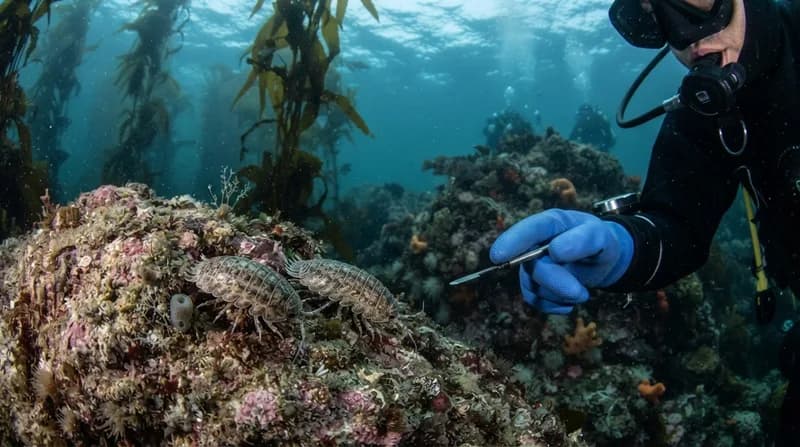
The first of the two discoveries, Callipallene pilosuspedes, possesses a striking and somewhat unsettling physical profile. Its name is derived from Latin terms for 'hairy feet,' which aptly describes the long, curved spines covering the lower segments of its legs. Beyond its unique hairiness, the creature features piercing red eyes and a triangular mouth surrounded by sensitive tendrils, a feature that researchers have noted gives it a startling resemblance to the iconic Sarlacc pit from science fiction.

Perhaps most impressive is the creature's agility. Under microscopic observation, the research team documented the species using its ovigers—appendages typically used by males for carrying eggs—to perform a complex grooming ritual. By wrapping these appendages around its own legs, the sea spider effectively uses comb-like spines to strip away debris and maintain hygiene. This behavior suggests a level of physical dexterity rarely observed in such small marine invertebrates.

2. Tanystylum kiixin: An Ecosystem in Miniature

The second species, Tanystylum kiixin, offers a stark contrast to its cousin. Named in honor of a historic Indigenous village site, this species is defined by its compact form and limited physical flexibility. Unlike the agile Callipallene pilosuspedes, this sea spider lacks the long, reaching appendages necessary for sophisticated self-cleaning. As a result, the specimens collected were frequently found covered in dirt, debris, and a variety of tiny parasites.

The scientists describe this interaction as an 'ecosystem within an ecosystem.' Because the creature cannot effectively groom itself, it serves as a mobile habitat for other microscopic organisms. This biological trade-off highlights the extreme variety of evolutionary strategies present in the Salish Sea, proving that even within a single taxonomic group, survival strategies can differ wildly. The researchers noted that while only a small number of these spiders were cataloged during their field work, the region likely hides much more undiscovered diversity, waiting for future expeditions to bring them to light.


SPONSORED
The 5 Best Over-Ear ANC Headphones of 2026, Tested & Ranked
Editor's Pick Guide
92/100
Tech & Gadgets•12 min read

The 5 Best Over-Ear ANC Headphones of 2026, Tested & Ranked

We locked five over-ear ANC picks for 2026 — Sony WH-1000XM6, Bose QuietComfort Ultra 2, Soundcore Space One, Sennheiser Momentum 5, and Apple AirPods Max 2 — then stress-tested them on lab metrics, long-term owner truth, and live street prices.

Related Stories

Semantically matched articles, ranked by topic overlap and freshness.

The Mysterious Surge: Colorectal Cancer Rates Rise After Two Decades of Decline
Science

The Mysterious Surge: Colorectal Cancer Rates Rise After Two Decades of Decline

A significant new study reveals an alarming reversal in colorectal cancer trends, with rising incidence rates now spanning nearly every age group under 70.

Paleontologists Unveil Global 'Treasure Map' to Unearth Earth’s Hidden Fossil History
Science

Paleontologists Unveil Global 'Treasure Map' to Unearth Earth’s Hidden Fossil History

A groundbreaking new analytical tool is helping scientists pinpoint exactly where the next major fossil discoveries are likely hidden, shifting the focus toward overlooked recent geological eras.

The Hidden Guardian: How TRF2 Controls Muscle Regeneration
Science

The Hidden Guardian: How TRF2 Controls Muscle Regeneration

Researchers have discovered that a protein previously known for protecting DNA plays a vital role in muscle repair, potentially opening new pathways for treating muscular dystrophy.

A Breakthrough in Metabolism: China Clears First Oral GLP-1 Pill
Science

A Breakthrough in Metabolism: China Clears First Oral GLP-1 Pill

Eli Lilly's Muyouda becomes the first oral GLP-1 weight-loss treatment approved in China, marking a significant shift away from injectable therapies.

New Machine Learning Project PERISCOPE Outperforms Traditional Heart Attack Risk Scoring
Science

New Machine Learning Project PERISCOPE Outperforms Traditional Heart Attack Risk Scoring

A breakthrough in cardiac care, the PERISCOPE project uses machine learning to accurately predict post-heart attack mortality rates, potentially revolutionizing patient monitoring.

Closing the Loop: How AI is Decoding the Human Brain to Restore Sight
Science

Closing the Loop: How AI is Decoding the Human Brain to Restore Sight

Researchers have successfully used deep learning to harmonize brain-computer interfaces, making bionic vision more predictable and personalized for the blind.

Unlocking the Neural Mysteries of Dyscalculia: Why Some Children Struggle with Math
Science

Unlocking the Neural Mysteries of Dyscalculia: Why Some Children Struggle with Math

New Stanford research reveals that math learning difficulties may stem from brain-level challenges in cognitive flexibility and strategy management rather than a simple inability to calculate.

New Data Reveals Significant Drop in Infant Mortality Across England
Science

New Data Reveals Significant Drop in Infant Mortality Across England

New national health data shows a 16% reduction in infant mortality rates in some of England's most disadvantaged areas, driven by the expansion of targeted perinatal care bundles.