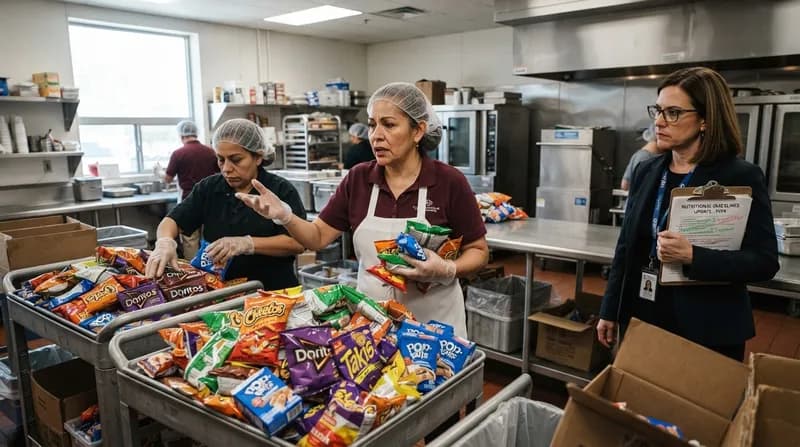
The Policy Shift: California's Real Food, Healthy Kids Act
Starting July 2029, a landmark piece of legislation known as the Real Food, Healthy Kids Act (AB 1264) will set in motion a transformative change for California public schools. The law mandates a phased elimination of ultra-processed foods—defined as items containing specific artificial additives, high levels of sugar, fat, or salt—from school menus by 2035. While the objective is to mitigate the risk of obesity, type 2 diabetes, and cardiovascular disease among youth, a recent study from Stanford Medicine highlights that the road to implementation is paved with significant, systemic obstacles.
Fiscal and Supply Chain Constraints
For school food service directors, the most immediate barrier is financial. Ultra-processed foods have long been the backbone of school cafeteria logistics because they are shelf-stable, inexpensive, and designed for high-speed, heat-and-serve preparation. Transitioning to scratch-cooked meals requires a paradigm shift that current federal and state reimbursement models—which hover around $4.60 per lunch—struggle to cover. As districts seek cleaner labels, they are finding that specialized, additive-free ingredients often come at a premium price, creating procurement shortages for items as simple as compliant pickles or bread products.
Furthermore, the reliance on the U.S. Department of Agriculture’s commodity food program often steers schools toward processed items. Schools frequently exchange raw commodities, such as bulk chicken, for pre-processed, heat-and-serve products like nuggets. Breaking this cycle requires a fundamental restructuring of how schools source and process food, which is currently beyond the capacity of many districts.
Infrastructure and Labor Challenges
Beyond the budget, there is the issue of physical infrastructure. A significant number of school kitchens are configured strictly for reheating frozen or pre-packaged meals. Converting these facilities to accommodate raw ingredient preparation is a massive capital undertaking, requiring expensive upgrades such as industrial-grade ventilation hoods, specialized sinks, and complex drainage systems. For many districts, these costs fall outside the scope of cafeteria budgets, landing instead in the lap of broader school district infrastructure funds, which are already severely limited.
Staffing also presents a daunting hurdle. Many cafeteria employees are currently part-time staff trained primarily in heating and serving. Shifting to scratch cooking requires a highly skilled workforce capable of food preparation, safety, and nutrition planning. Moving from part-time, service-oriented roles to full-time, culinary-focused positions demands an increase in salary and benefits that many districts simply cannot afford without significant state-level intervention.
Why It Matters
- Health Outcomes: Universal school meals serve two out of every three daily meals for many students; the nutritional quality of these meals has a long-term impact on public health.
- Economic Reality: While scratch cooking is healthier, it requires an upfront investment that current school budgets are not equipped to handle.
- Policy Sustainability: Short-term grant funding is insufficient for systemic change; schools require sustainable, long-term funding models to make these transitions permanent.
Ultimately, while the vision of a whole-food, healthy school menu is a vital investment in the next generation, researchers emphasize that success depends on more than just setting a mandate. It requires lawmakers to back these directives with the necessary funding and technical support to ensure that school districts can actually build the culinary infrastructure required to move away from the industrial food model.