Beyond Enchantment: The Mathematics of Romance
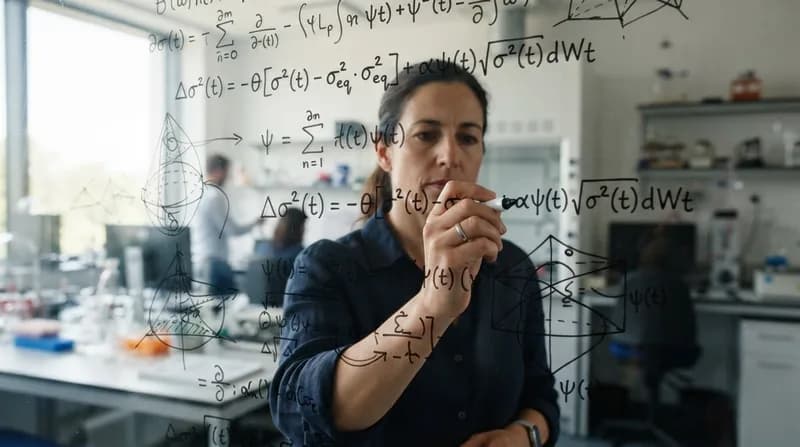
For centuries, poets and novelists have insisted that love is a force beyond explanation, an ethereal phenomenon governed by fate or whim. However, contemporary researchers are challenging this notion by applying the cold, hard logic of mathematics to the dynamics of human affection. By treating romantic feelings as dynamical systems—similar to how scientists model predator-prey interactions or population shifts—experts are uncovering the hidden structural patterns that determine whether a relationship flourishes or fades.
Professor Laurent Pujo-Menjouet, author of Love! Valour! Equations!, is at the forefront of this movement. Rather than attempting to predict the next great romance, his work focuses on the resilience of established pairs. By utilizing models rooted in biological population studies, such as the Allee effect—which tracks when a population drops below a critical sustainability threshold—scientists can identify when a couple enters a 'danger zone' where the bond becomes increasingly difficult to repair.
The Anatomy of Stability
The mathematical framework for understanding relationships has evolved significantly since the early work of John Gottman, whose pioneering efforts mapped emotional interactions into actionable graphs. Modern researchers have integrated complex variables, such as 'delayed reactions,' to account for the gap between a perceived offense and an emotional response. This delay is often the deciding factor in whether a conflict de-escalates or spirals into irreparable damage.
According to Pujo-Menjouet, the stability of a long-term bond rests upon three fundamental pillars:
- Mutual Attraction: The baseline intensity of the bond that draws two people together.
- Emotional Decay: The natural attenuation of passion that occurs over time as novelty fades and routine sets in.
- Rebound Resilience: The capability of both partners to return to a state of equilibrium after being destabilized by life’s inevitable stressors, such as financial pressure, illness, or career fatigue.
The core philosophy here is not that relationships should be void of conflict, but that they must demonstrate enough structural integrity—what Pujo-Menjouet describes as building a 'brick house'—to withstand external pressures. The math suggests that the most successful couples are not necessarily those who argue the least, but those who possess the highest mathematical probability of recovering their emotional baseline quickly.
The Future: A Relationship GPS
Looking ahead, there is significant interest in marrying these mathematical models with artificial intelligence. The goal is to create a digital early-warning system—a sort of 'relationship GPS'—that could provide partners with real-time feedback on the health of their bond. By analyzing behavioral trends, such a system could theoretically signal when a relationship is veering toward an unstable state, offering an opportunity for proactive course correction before the damage becomes permanent.
However, the researchers are quick to inject a note of caution. These models are essentially navigational aids rather than oracles. Human behavior remains inherently unpredictable, influenced by cultural nuances, socioeconomic backgrounds, and personal choices that defy simple binary outcomes. Ultimately, these equations serve to illuminate the path forward, but they cannot replace the conscious, daily commitment required to sustain a healthy connection. As we move into an era of data-driven intimacy, the mathematics of love provides the map, but the participants themselves must still choose to walk the trail.