A New Paradigm for Safety
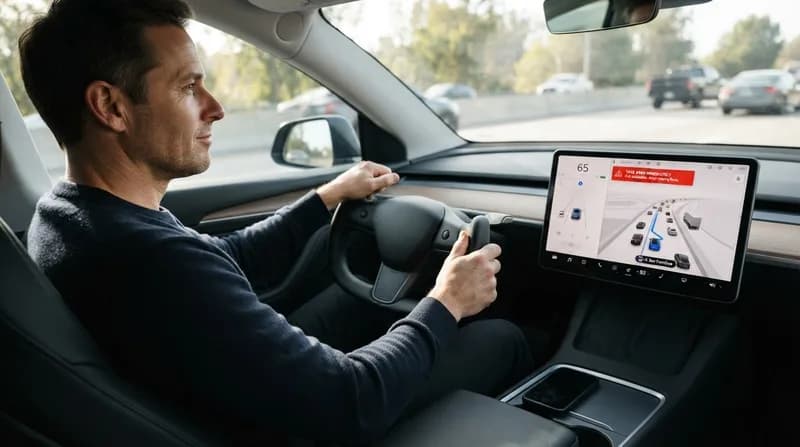
Tesla has introduced a significant shift in its Full Self-Driving (Supervised) strategy with the release of software version 14.3.9. Traditionally, advanced driver assistance systems (ADAS) have functioned under the premise that the human driver remains the primary supervisor of the automated technology. However, this latest update reverses that dynamic: the FSD system now acts as an active safety layer that monitors the vehicle even while it is being manually controlled.
The core objective of this update is to prevent accidents that occur due to human error or distraction. According to the release notes, the vehicle will autonomously intervene in two critical scenarios: when a head-on collision is deemed imminent where braking alone is insufficient, and when the system detects that the driver is dangerously distracted or has unintentionally deactivated the assistance system. By re-engaging FSD (Supervised) during these emergency windows, the car aims to mitigate damage or avoid collisions entirely, effectively acting as an intelligent co-pilot that watches the human driver as much as the road ahead.
Expanding Horizons in Europe
Beyond the technical update, Tesla’s regulatory footprint in Europe continues to grow. Slovenia has officially cleared the FSD (Supervised) suite for use on its public roads, making it the sixth European nation to grant such authorization. This momentum follows previous approvals in the Netherlands, Denmark, Belgium, Estonia, and Lithuania, signaling a slow but steady integration of Tesla’s automation stack into the European landscape.
To support its bid for broader EU-wide adoption ahead of a critical regulatory vote scheduled for October 6, 2026, Tesla has launched an interactive online dashboard. This repository provides transparency regarding the performance of FSD (Supervised), including accident data and total distances driven under the system’s guidance. The company’s messaging is clear: it intends to demonstrate that the technology provides tangible safety benefits that are currently being sidelined by regional bureaucratic processes.
Why It Matters
- Proactive Safety: By monitoring the driver for distraction, Tesla is acknowledging the reality of human fatigue in modern traffic.
- Shift in Liability/Role: The transition of FSD from a user-monitored system to a system that audits human performance represents a major evolution in how vehicle autonomy is perceived.
- Regulatory Push: The publication of performance data is a strategic move to sway EU authorities, highlighting the tension between rapid software innovation and established transport safety regulations.
As Tesla continues to refine its FSD (Supervised) stack, the industry is closely watching how these autonomous intervention features perform in real-world scenarios. With the promise of near-flawless performance cited by some users, this safety-first update serves as a critical bridge between today's supervised driving and the long-term goal of fully autonomous transport.