The Arrival of the Pedal-Free Taxi
Tesla’s vision for a future without steering wheels or pedals is no longer confined to controlled test tracks or investor presentations. The purpose-built Cybercab has officially begun carrying passengers on public roads in Austin, Texas. This milestone represents a tangible shift from concept to reality, as the vehicle—distinctly lacking any traditional driver controls—navigates real-world traffic conditions.
Recent footage captured inside the vehicle showcases a remarkably unremarkable experience. For proponents of autonomous driving technology, this “boring” performance is the ultimate goal. The ride, which involved negotiating city streets, speed bumps, and standard urban maneuvers, was characterized by smooth acceleration and steady handling. By stripping away the driver's seat interface, Tesla has leaned into the robotaxi format, focusing entirely on passenger comfort and the automated journey.
The In-Cabin Experience
Stepping inside the Cybercab reveals an interior designed for utility and comfort rather than active operation. The vehicle features a two-seat bench arrangement that offers surprising legroom, despite the compact footprint of the exterior. The rear bench is adjustable, allowing for both sliding and reclining, which elevates the level of luxury one might expect from a ride-hailing service.
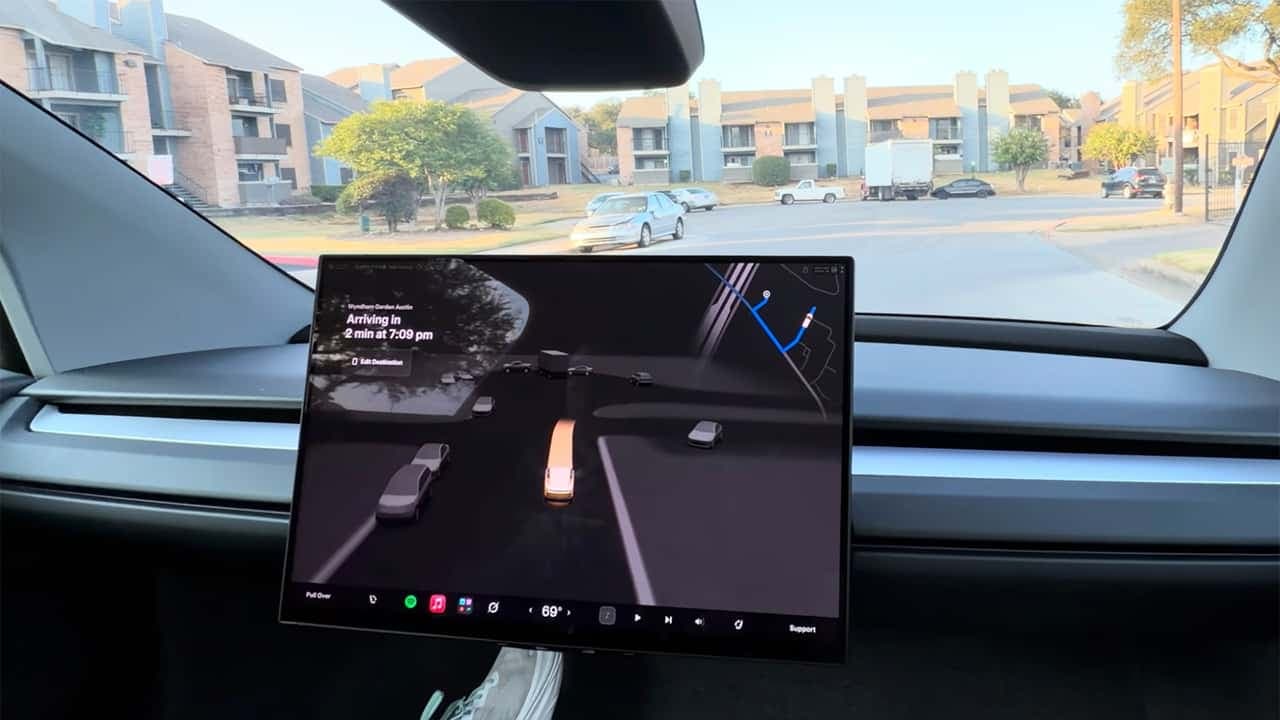
Interaction with the car is mediated entirely through a large, approximately 21-inch central touchscreen. This interface acts as the command center for the entire trip, handling everything from climate control and seating adjustments to opening and closing the signature butterfly doors. Passengers simply tap "Start Ride" to initiate the journey, effectively turning the vehicle into a mobile lounge that prioritizes the rider’s experience over manual piloting.
Why It Matters
- Hardware Milestone: The transition from simulation to public street testing confirms that Tesla has moved past the prototype stage, with dozens of units already registered in Texas.
- Redefining Mobility: By removing the steering wheel and brake pedals, the Cybercab challenges the traditional automotive paradigm and accelerates the development of dedicated ride-hailing hardware.
- The "Boring" Benchmark: The success of the initial public rides demonstrates that automated systems are increasingly capable of handling standard driving tasks with the predictability of a human driver.
The Road Ahead
While the initial public demonstrations in Austin have been smooth, the industry remains cautious. Navigating a geofenced, clear-weather route in Texas is a far cry from the complex, high-pressure environments found in cities like New York, where dense pedestrian traffic, unpredictable road work, and extreme weather patterns test the true limits of AI perception.
Moreover, the integration of voice assistants like Grok into the driving experience remains in its infancy. While the technology is impressive, small misinterpretations—such as confusing a temperature adjustment request for a navigational change—highlight the nuance still required for fully autonomous systems to become truly seamless. As Tesla expands its fleet and enters more diverse environments, the focus will shift from simply "driving" to reliably navigating the chaotic, unpredictable nature of real-world urban infrastructure.