The Evolution of Prefabricated Charging
Tesla continues to aggressively refine its infrastructure strategy, recently unveiling a new category of prefabricated hardware known as the 'Accordion' Supercharger. This innovative deployment system represents a significant shift from traditional construction-heavy methods, aiming to streamline the rollout of high-capacity charging networks in high-traffic regions. By moving the majority of the assembly process from the job site to the factory floor, Tesla is effectively removing months of ground-up site work and complex electrical integration from the equation.
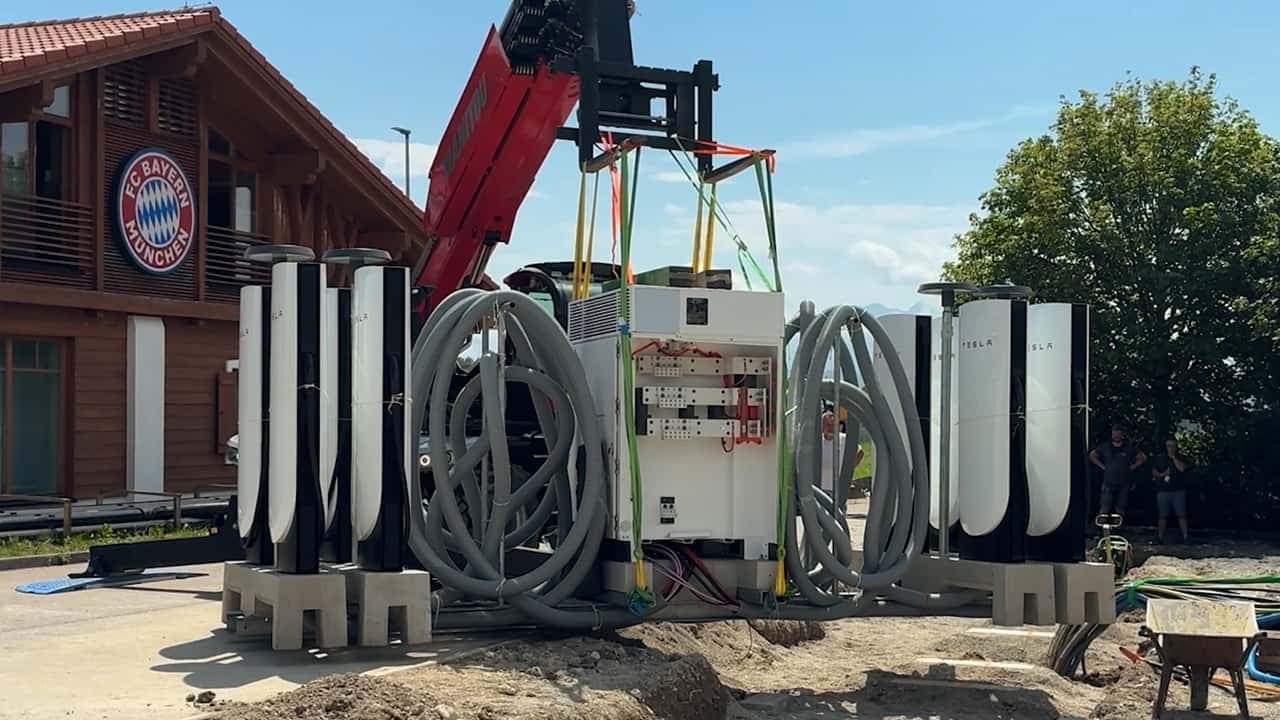
The concept hinges on an all-in-one approach where eight individual charging stalls are bundled alongside a high-performance V4 power cabinet. Everything from the structural base to the intricate cable management is finalized before the unit ever leaves the facility. Once delivered, the system is designed for a seamless, forklift-assisted installation, allowing for near-instant commissioning. This modular efficiency is not merely an engineering convenience; it is a strategic necessity for keeping pace with the exponential growth of EVs on the road.
Technical Specifications and Performance
At the heart of the Accordion unit is Tesla’s latest V4 technology, which sets a new benchmark for charging throughput. The system is engineered to handle peak demands, with the power cabinet rated at a massive 1.2 megawatts. This capability allows the individual dispensers to support charging speeds of up to 500 kilowatts, catering to the increasingly demanding power requirements of modern electric vehicles. By standardizing this hardware within a modular frame, Tesla ensures that performance remains consistent regardless of the installation site.
Logistically, the design is highly optimized for transportation. A single truckload is capable of carrying two complete Accordion systems, totaling 16 charging stalls. Because each pair of stalls arrives pre-mounted on a factory-fabricated concrete base, the physical footprint of the site requires only minimal preparation—typically just leveling and connection to the local grid. This reduction in on-site labor and materials is responsible for a reported 20% decrease in total installation costs compared to legacy charging configurations.
Why It Matters
The transition toward pre-assembled, modular infrastructure is a critical step in overcoming the 'chicken and egg' problem of the EV era: the need for massive scale without prohibitive capital expenditure. As the automotive industry shifts toward more power-hungry vehicles, the ability to deploy robust, high-voltage networks quickly will define the market winners. The Accordion unit, alongside the previously introduced 'Folding' Supercharger units, underscores Tesla’s commitment to turning charging station construction into a product-based manufacturing process rather than a site-specific construction project. With the first of these stations already active in Irschenberg, Germany, the company is proving that these prefabricated solutions are not just theoretical, but are ready for mass deployment across global markets.