The Rise of the eTopas 600
Two years after making its debut at the IAA Transportation expo as a bold prototype, SuperPanther has successfully transitioned from conceptual design to series production. The company’s flagship heavy-duty electric truck, the eTopas 600, is now rolling off assembly lines at the Steyr Automotive facility in Austria. The vehicle has already entered active duty, operating fleets across six European nations, including Germany, Switzerland, and the Netherlands. Among its notable deployments is a partnership with DHL Freight, where the truck has been navigating cross-border routes between the Netherlands and Belgium, logging approximately 2,000 kilometers per week.
SuperPanther has placed a premium on efficiency and weight optimization. The eTopas 600 boasts a curb weight of just 10.875 tonnes—including the Intelligent Power Take-Off (IPTO)—a figure that undercuts the firm's own 11-tonne target. This reduction in mass is a strategic advantage in the long-haul sector, as it allows for a higher net payload, directly impacting the economic viability of the vehicle for logistics providers. Real-world performance data shows the vehicle achieving an average consumption rate of 91 to 95 kWh per 100 kilometers under full load, an efficiency level the manufacturer credits to its proprietary axle development and sophisticated software management.
Bridging the Infrastructure Gap with Dual-CCS
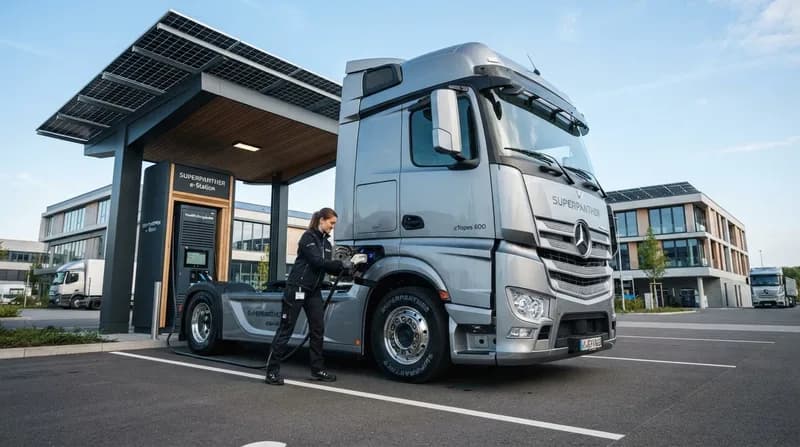
A major challenge for electric long-haul trucking remains the scarcity of high-power charging infrastructure. SuperPanther has addressed this by implementing a dual-CCS charging solution, which allows the eTopas 600 to pull up to 660 kW of power. This configuration enables the battery to charge from 20 to 80 percent in just 38 minutes, effectively turning potential downtime into a manageable break for drivers. According to company leadership, this dual-port setup acts as a critical bridge until the Megawatt Charging System (MCS) becomes the industry standard.
Despite the current reliance on dual-CCS, the company is not ignoring the future. SuperPanther has already demonstrated a version of the truck equipped with an MCS connector, signaling a readiness to transition as the grid evolves. Furthermore, the eTopas 600 features built-in Vehicle-to-Grid (V2G) capabilities, allowing it to potentially interact with local power grids. To further ease adoption, the company is collaborating with various energy providers to assist fleet owners in building the necessary charging infrastructure along their specific operational corridors.
Scaling Service and Strategic Growth
As SuperPanther moves from its initial market-entry phase to mass-market scaling, its focus has shifted toward building a robust support ecosystem. Recognizing that traditional workshop networks are often unprepared for electrified commercial fleets, the manufacturer is taking a localized approach. They are either qualifying existing workshops or training internal customer staff to handle maintenance. This is complemented by mobile “Flying Doctors” teams and 24/7 service availability to ensure maximum fleet uptime.
Looking ahead, the firm is setting its sights on rapid growth. Following an initial target of 80 to 100 units for 2026, the company plans to scale production to several hundred vehicles in the coming year. Frank Schulz, Head of Sales for Europe, maintains that the eTopas 600 is already delivering a lower Total Cost of Ownership (TCO) compared to traditional diesel-powered trucks, provided the utilization rate is high. As these vehicles log more miles across the continent, the data gathered will be essential in proving that heavy-duty electrification is not just a sustainable vision, but an immediate commercial reality.
Key Specifications: eTopas 600
- Range: Up to 560 km
- Curb Weight: 10.875 tonnes
- Charging: Dual-CCS (up to 660 kW)
- Charging time (20-80%): 38 minutes
- Operational regions: Germany, Netherlands, Poland, Czechia, Austria, Switzerland