ScienceTechnical Deep Dive

SpaceX Achieves Historic Starship Launch and Reusability Milestone

Published
EElectricBuzz Editorial Team
SpaceX Achieves Historic Starship Launch and Reusability Milestone
2 min read276 wordsElectricBuzz Editorial Team

The Gist

“SpaceX continues to push the boundaries of orbital flight as the latest Starship mission targets the ambitious goal of full vehicle recovery.”

The Path to Full Reusability

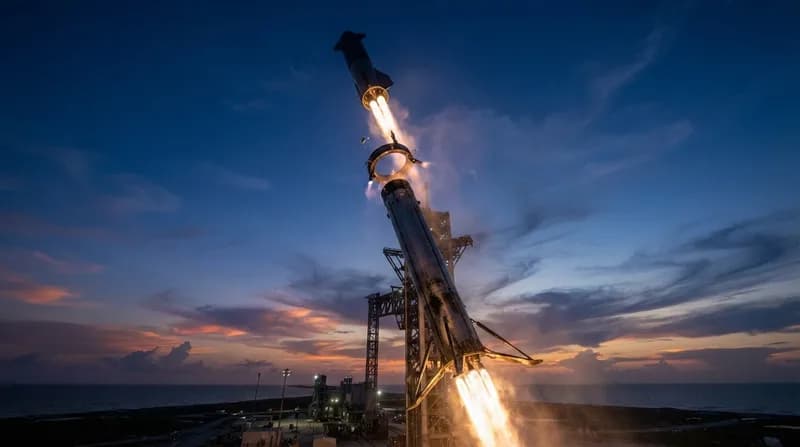
SpaceX has successfully executed another high-stakes flight test of its massive Starship launch vehicle from the Starbase facility in South Texas. This mission serves as a critical milestone in the company’s ongoing efforts to master the rapid reusability of the world’s most powerful rocket. By attempting to return both the Super Heavy booster and the Starship upper stage, the aerospace giant is aiming to fundamentally alter the economics of space travel.

The test flight focused on refining the precise maneuvers required for vertical landings. Achieving the capability to recover both sections of the vehicle represents a major technical hurdle, moving the industry closer to a future where orbital transit is as routine and affordable as commercial aviation. Engineers are carefully monitoring telemetry data from this flight to validate the structural integrity and thermal protection systems required for the craft to survive reentry and touchdown.

Why It Matters

  • Cost Reduction: Full reusability is the primary mechanism for SpaceX to slash the price-per-kilogram of orbital payloads.
  • Deep Space Logistics: Mastery of these flight profiles is essential for future crewed missions to the Moon and Mars.
  • Rapid Turnaround: Proving the vehicle can land safely paves the way for a launch cadence that supports a permanent human presence in space.

The implications of this test extend far beyond the immediate mission success. As the hardware continues to demonstrate maturity, the focus shifts toward increasing operational reliability. If the integration of recovery systems continues at this trajectory, Starship is poised to become the definitive workhorse for the next generation of satellite deployments and scientific research missions, cementing its place as a cornerstone of modern space infrastructure.


SPONSORED
The 5 Best Over-Ear ANC Headphones of 2026, Tested & Ranked
Editor's Pick Guide
92/100
Tech & Gadgets•12 min read

The 5 Best Over-Ear ANC Headphones of 2026, Tested & Ranked

We locked five over-ear ANC picks for 2026 — Sony WH-1000XM6, Bose QuietComfort Ultra 2, Soundcore Space One, Sennheiser Momentum 5, and Apple AirPods Max 2 — then stress-tested them on lab metrics, long-term owner truth, and live street prices.

Related Stories

Semantically matched articles, ranked by topic overlap and freshness.

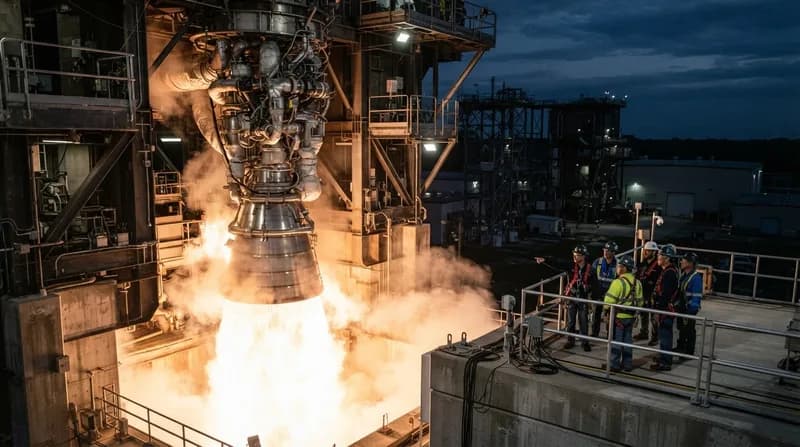
NASA Ignites RS-25 Engine in High-Stakes Test for Artemis Moon Missions
Science

NASA Ignites RS-25 Engine in High-Stakes Test for Artemis Moon Missions

NASA successfully completed a critical 200-second hot fire test of its RS-25 engine, bolstering the technical readiness of the Space Launch System for upcoming lunar landings.

Mapping the Invisible: Breakthrough Imaging Reveals Hidden Brain Structures
Science

Mapping the Invisible: Breakthrough Imaging Reveals Hidden Brain Structures

Researchers have developed a high-speed electron tomography technique that uncovers previously unseen nanoscale structures in the brain, including mysterious cellular 'nibbling' behaviors.

Quantum Ticking: Scientists Propose Method to Detect Time Superposition
Science

Quantum Ticking: Scientists Propose Method to Detect Time Superposition

Researchers have unveiled a theoretical model that could allow atomic clocks to observe time flowing at multiple rates simultaneously, potentially bridging the gap between quantum mechanics and general relativity.

Nature’s GPS: How Bogong Moths Master Long-Distance Nocturnal Navigation
Science

Nature’s GPS: How Bogong Moths Master Long-Distance Nocturnal Navigation

New research reveals that the humble Bogong moth employs a sophisticated dual-navigation system, utilizing both starlight and the Earth’s magnetic field to complete its epic 1,000 km migration.

A Cosmic Collision: James Webb Captures the Aftermath of a Stellar Merger
Science

A Cosmic Collision: James Webb Captures the Aftermath of a Stellar Merger

Astronomers have witnessed a rare stellar merger in the Andromeda galaxy, using the James Webb Space Telescope to document the violent union of a supergiant star and its companion.

The Brain Gap: New Research Reveals AI Doesn't 'Think' Like Us
Science

The Brain Gap: New Research Reveals AI Doesn't 'Think' Like Us

A study from York University challenges the long-held belief that artificial neural networks process visual data similarly to the human brain.

Crafting the 'Unicorn Career': Navigating Professional Uncertainty in the Age of AI
Science

Crafting the 'Unicorn Career': Navigating Professional Uncertainty in the Age of AI

STEM career expert Alaina G. Levine breaks down how to design a deeply personal, value-aligned career trajectory in a rapidly shifting technological landscape.

Cracking the Barium Titanate Code: A Quantum Leap for Optical Networking
Science

Cracking the Barium Titanate Code: A Quantum Leap for Optical Networking

A joint research team has finally decoded the complex optical properties of barium titanate, clearing the path for faster, more efficient data transmission.