ScienceTechnical Deep Dive

NASA Ignites RS-25 Engine in High-Stakes Test for Artemis Moon Missions

Published
EElectricBuzz Editorial Team
NASA Ignites RS-25 Engine in High-Stakes Test for Artemis Moon Missions
3 min read447 wordsElectricBuzz Editorial Team

The Gist

“NASA successfully completed a critical 200-second hot fire test of its RS-25 engine, bolstering the technical readiness of the Space Launch System for upcoming lunar landings.”

Advancing the Space Launch System

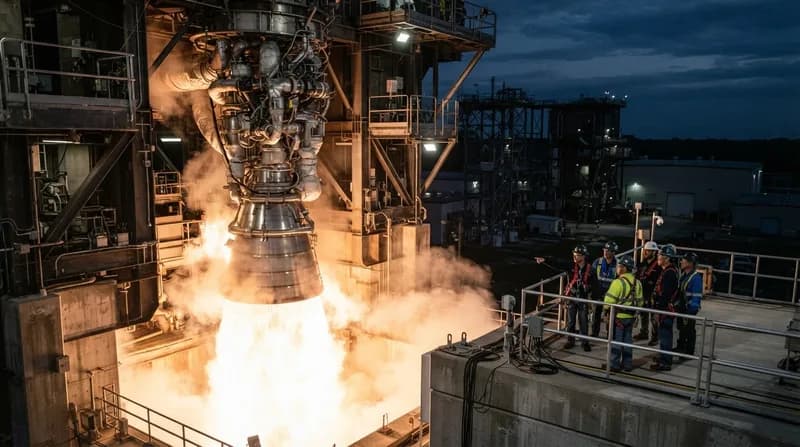
In a powerful demonstration of propulsion capability, NASA engineers recently executed a successful 200-second hot fire test of the RS-25 rocket engine. Conducted on November 18, 2026, at the historic Fred Haise Test Stand at the Stennis Space Center in Mississippi, the test serves as a vital milestone in the agency's broader Artemis program. The engine, identified as unit No. 10001, operated for its full, scheduled duration, providing researchers with essential telemetry and performance metrics.

While this particular unit is a developmental model not intended for actual flight, the data harvested from this "hot fire" is indispensable. By subjecting the hardware to the extreme thermal and pressure environments synonymous with a real launch, NASA and its industrial partner, L3Harris Technologies, can refine the power output, thermal efficiency, and overall operational reliability of the engines that will eventually propel astronauts into deep space.

The Road to Artemis IV and Beyond

The success of this ground test is inextricably linked to the Artemis IV mission, which is currently slated for a 2028 launch. Artemis IV represents a major leap forward for NASA, moving beyond preliminary lunar flybys to actual surface landings. These missions rely heavily on the Space Launch System (SLS), a colossal rocket architecture that utilizes four RS-25 engines to generate a staggering 2 million pounds of thrust. This immense power is the primary catalyst needed to escape Earth’s gravitational pull and set the Orion spacecraft on its trajectory toward the Moon.

Beyond the immediate goal of lunar exploration, the tests performed at the Stennis Space Center are designed to build a foundation for human activity on the Moon's South Pole. Establishing a sustained presence on the lunar surface is considered the ultimate proving ground for the technologies required for the next great frontier: a crewed journey to Mars. Every second of data collected at the Fred Haise stand serves to de-risk these future interplanetary endeavors.

Why This Test Matters

  • Reliability Verification: Validating engine performance under extreme, flight-like conditions ensures the safety of the crewed Artemis missions.
  • Technological Refinement: Collaborative efforts between NASA, L3Harris, and Nova Space Solutions allow for continuous iterative improvements in propulsion efficiency.
  • Mars Preparation: The Artemis program is the core framework for developing the deep-space infrastructure necessary for a future mission to Mars.
  • Operational Readiness: Successful ground tests confirm that the manufacturing and maintenance pipelines for the SLS rocket remain on schedule for the 2028 target.

As the agency continues to push the boundaries of propulsion technology, these engine tests remain the bedrock of American deep-space exploration. The collaboration between public-sector oversight and private-sector engineering continues to yield the high-performance hardware essential for humanity's return to the lunar landscape.


SPONSORED
The 5 Best Over-Ear ANC Headphones of 2026, Tested & Ranked
Editor's Pick Guide
92/100
Tech & Gadgets•12 min read

The 5 Best Over-Ear ANC Headphones of 2026, Tested & Ranked

We locked five over-ear ANC picks for 2026 — Sony WH-1000XM6, Bose QuietComfort Ultra 2, Soundcore Space One, Sennheiser Momentum 5, and Apple AirPods Max 2 — then stress-tested them on lab metrics, long-term owner truth, and live street prices.

Related Stories

Semantically matched articles, ranked by topic overlap and freshness.

Mapping the Invisible: Breakthrough Imaging Reveals Hidden Brain Structures
Science

Mapping the Invisible: Breakthrough Imaging Reveals Hidden Brain Structures

Researchers have developed a high-speed electron tomography technique that uncovers previously unseen nanoscale structures in the brain, including mysterious cellular 'nibbling' behaviors.

Quantum Ticking: Scientists Propose Method to Detect Time Superposition
Science

Quantum Ticking: Scientists Propose Method to Detect Time Superposition

Researchers have unveiled a theoretical model that could allow atomic clocks to observe time flowing at multiple rates simultaneously, potentially bridging the gap between quantum mechanics and general relativity.

Nature’s GPS: How Bogong Moths Master Long-Distance Nocturnal Navigation
Science

Nature’s GPS: How Bogong Moths Master Long-Distance Nocturnal Navigation

New research reveals that the humble Bogong moth employs a sophisticated dual-navigation system, utilizing both starlight and the Earth’s magnetic field to complete its epic 1,000 km migration.

A Cosmic Collision: James Webb Captures the Aftermath of a Stellar Merger
Science

A Cosmic Collision: James Webb Captures the Aftermath of a Stellar Merger

Astronomers have witnessed a rare stellar merger in the Andromeda galaxy, using the James Webb Space Telescope to document the violent union of a supergiant star and its companion.

The Brain Gap: New Research Reveals AI Doesn't 'Think' Like Us
Science

The Brain Gap: New Research Reveals AI Doesn't 'Think' Like Us

A study from York University challenges the long-held belief that artificial neural networks process visual data similarly to the human brain.

Crafting the 'Unicorn Career': Navigating Professional Uncertainty in the Age of AI
Science

Crafting the 'Unicorn Career': Navigating Professional Uncertainty in the Age of AI

STEM career expert Alaina G. Levine breaks down how to design a deeply personal, value-aligned career trajectory in a rapidly shifting technological landscape.

Cracking the Barium Titanate Code: A Quantum Leap for Optical Networking
Science

Cracking the Barium Titanate Code: A Quantum Leap for Optical Networking

A joint research team has finally decoded the complex optical properties of barium titanate, clearing the path for faster, more efficient data transmission.

BepiColombo’s X-Ray Vision: A Deep-Space Triumph Eight Years in the Making
Science

BepiColombo’s X-Ray Vision: A Deep-Space Triumph Eight Years in the Making

After an eight-year journey spanning 10 billion kilometers, the BepiColombo mission has successfully activated its groundbreaking X-ray telescope, signaling a new era for planetary exploration.