Revolutionizing Rural Ophthalmic Care
In regions where ophthalmological specialists are scarce, cataracts remain a leading cause of preventable blindness, affecting nearly 100 million individuals globally. To address this, researchers have unveiled a novel, low-cost hardware solution that transforms standard smartphones into sophisticated diagnostic tools. Developed through a collaboration between Johns Hopkins University and the Aravind Eye Care System, this innovation is designed to move beyond traditional, logistically heavy 'eye camp' models, offering a more scalable, accessible method for community-based screening.
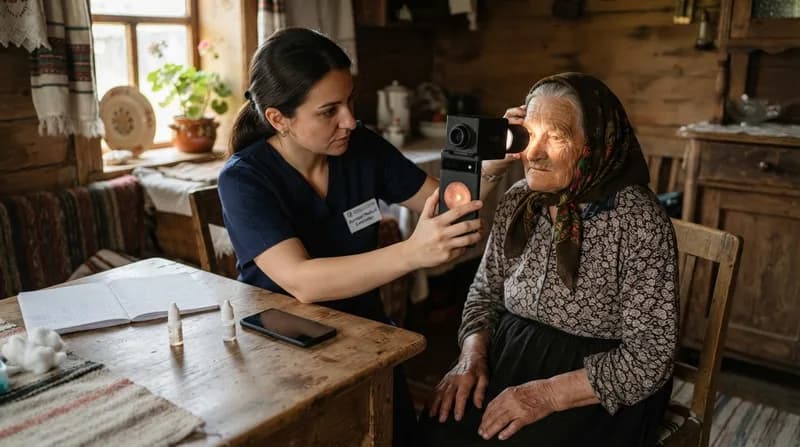
The system consists of a compact, portable attachment that clips directly onto an Android device. This hardware includes a magnification lens, dual white LEDs for consistent illumination, and a specialized silicone scope. The scope is engineered to rest securely against the patient's eye socket, effectively blocking ambient light to maintain a precise focal distance. The entire assembly, including the smartphone, costs less than £150, making it an exceptionally affordable solution for resource-constrained environments.
Validation and Clinical Accuracy
The efficacy of this technology was tested in a rigorous field study involving 1,093 patients across 19 rural camps in Tamil Nadu, India. After receiving only three hours of training, community health workers were able to capture high-resolution images of the eye in under 2.5 minutes per patient. These images were then transmitted to ophthalmologists who provided remote assessments. The results were striking: in 96 out of every 100 cases, the remote specialist and the on-site doctor reached the same conclusion regarding the necessity for hospital referral.
Agreement rates for specific conditions were equally promising. Remote clinicians accurately identified mature cataracts in 96% of cases and correctly identified healthy crystalline lenses in 89% of instances. These findings suggest that the physical presence of a specialist is not always a prerequisite for accurate triage. By decentralizing the screening process, the platform allows medical experts to focus their limited time on high-level decision-making and surgical interventions rather than routine field examinations.
Why it Matters: The Future of Remote Triage
- Scalability: By utilizing non-specialist community health workers, health systems can scale screening efforts without needing to proportionally increase the number of ophthalmologists.
- Low-Bandwidth Compatibility: The paired software is optimized for areas with limited internet connectivity, ensuring that diagnostic data can be reliably transmitted from rural hubs.
- Operational Efficiency: The technology eliminates the reliance on expensive, episodic mobile clinics, enabling a transition toward sustainable, door-to-door, or local-point-of-care screening.
- Future-Proofing: The platform is architected to be compatible with future AI-based grading algorithms, which will further streamline triage by automatically filtering out cases that do not require an immediate expert review.
Outlook and Future Implications
While the study demonstrates significant success in cataract detection, researchers emphasize that this is a screening tool, not a total replacement for comprehensive eye examinations. The system currently shows lower efficacy for non-lens conditions like pterygium, and further refinement is planned to include blue-light and slit-beam imaging capabilities. Looking ahead, the team aims to expand the scope of their research to include other global regions and integrate machine learning modules to automate the initial analysis of captured images.
As policymakers search for sustainable ways to improve healthcare equity, this smartphone-based approach provides a blueprint for how hardware innovation can bridge the gap in underserved communities. By combining robust physical hardware with existing community infrastructure, the project serves as a compelling example of how medical technology can be democratized, ensuring that geographic isolation no longer serves as a barrier to essential eye care.