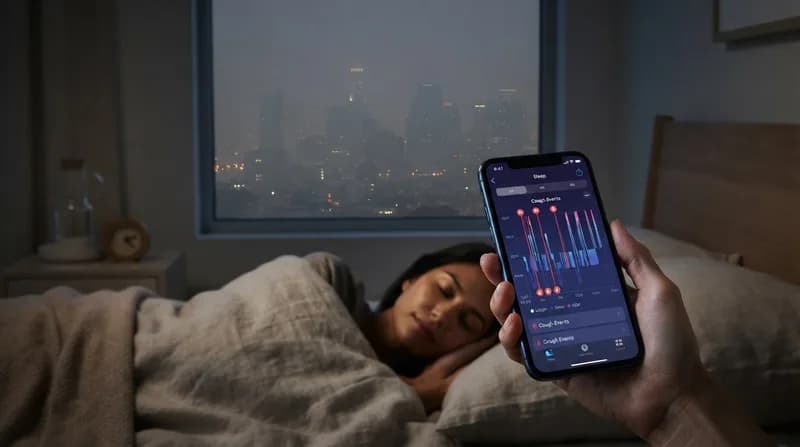
The Global Scale of Sleep Monitoring
Researchers from the University of Cambridge, Tsinghua University, and the sleep-tech firm Sleep Cycle have uncovered a startling connection between daily air pollution levels and the quality of human sleep. By aggregating anonymized data from millions of users across 32 cities and 12 countries, the team analyzed cough patterns over an 18-month period. This study represents one of the most comprehensive uses of smartphone-based health data to date, turning individual consumer devices into sophisticated environmental monitoring instruments.
The study, published in the journal Communications Health, utilized the Sleep Cycle mobile app to capture audio data. The app leverages local AI algorithms to detect and count coughs directly on the user's device, ensuring that sensitive audio data never leaves the handset. By pooling this information at the city level, researchers were able to create an unprecedented dataset that tracks health outcomes against real-time fluctuations in environmental particulate matter, specifically focusing on PM 2.5—tiny particles capable of penetrating deep into the lungs.
Quantifying the Connection
The results of the analysis are striking. Even when researchers accounted for major confounding factors—such as influenza outbreaks, seasonal weather changes, and local humidity—a consistent correlation remained. For every increase of 10 micrograms of particulate matter per cubic meter, there was a measurable 2.4% rise in coughing frequency among the user population. This trend held true across various geographic regions, from the urban centers of the United States to major cities in Europe, Asia, and Africa.
Perhaps most concerning is the study's finding regarding safety thresholds. The link between pollution and respiratory irritation remained statistically significant even in areas where air quality levels were well within the limits recommended by the World Health Organization. This observation suggests that the impact of airborne pollutants on lung health begins at levels previously considered negligible, highlighting the potential for long-term respiratory inflammation even in environments with relatively "clean" air.
Why it Matters
- Public Health Surveillance: This research demonstrates that mobile app data can provide a powerful, low-cost complement to traditional epidemiological research.
- Redefining Safety: The persistence of the cough-pollution link below current guidelines calls into question whether any level of particulate exposure is truly benign.
- Privacy-First Science: By performing AI-based analysis locally on the user's smartphone, the study proves that large-scale health data can be gathered without compromising individual privacy.
Moving Toward Mitigation
The researchers emphasize that while the study is observational, it provides a clear signal for individual health awareness. Dr. Tong Xia of Tsinghua University notes that while the occasional cough is common, it acts as an early warning sign of lung irritation that, if left unaddressed, could evolve into chronic conditions such as asthma or COPD. The findings suggest that on days with higher pollution alerts, even for those living in purportedly safe areas, practical steps like using high-quality indoor air filters or wearing masks might be necessary to protect sleep quality and overall respiratory health.
Looking forward, the integration of consumer technology into public health research appears to be on a rapid growth trajectory. As these devices continue to monitor physiological markers during the most vulnerable hours of the day, they provide scientists with a level of insight into human health that was previously restricted to expensive, clinical sleep laboratories. This massive, anonymized pool of data may prove essential in shaping future urban planning and environmental policies.