The Unfolding Seismic Mystery
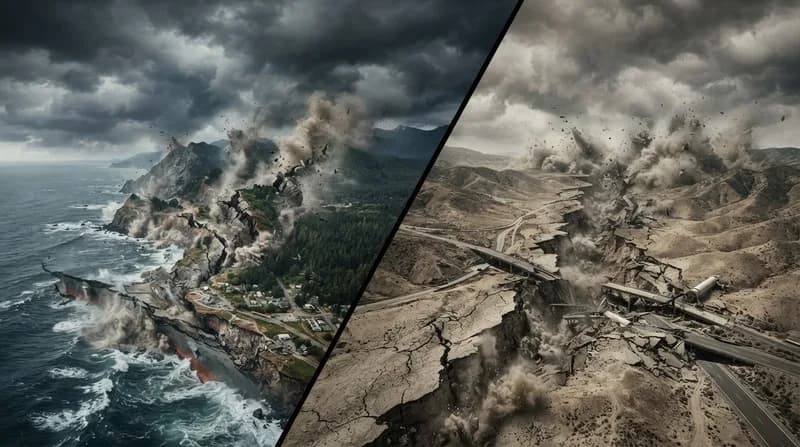
For decades, earthquake preparedness on the U.S. West Coast has centered on the looming threat of the "Big One"—a massive rupture of the Cascadia subduction zone. However, groundbreaking new research from Oregon State University suggests that the region’s seismic risk profile is significantly more complex and potentially more devastating than previously assumed. Evidence preserved in deep-sea sediment cores indicates that the Cascadia subduction zone and the northern San Andreas fault are not merely independent neighbors; they may possess a capacity for synchronization, unleashing powerful earthquakes within a compressed window of minutes or hours.
Led by marine geologist Chris Goldfinger, the research team analyzed 3,100 years of geologic history. By examining turbidites—sediment layers deposited by underwater landslides triggered by seismic shaking—the researchers identified distinctive "doublet" patterns. These structures suggest that when one fault ruptures, it can trigger the other, creating a high-magnitude, dual-fault disaster that would stretch national emergency response capabilities to their breaking point.
The "Doublet" Evidence
The discovery of this phenomenon was largely serendipitous. During a 1999 ocean expedition, a navigational error directed a research vessel into the region near Cape Mendocino, where the Cascadia and San Andreas systems converge. Drilling into the ocean floor, the team discovered a highly anomalous sediment core. While normal turbidite deposits show larger, coarser material settling at the base, this core displayed the reverse: fine silt at the bottom topped by coarse sand. This inverted layering provided the "smoking gun" for rapid-fire, back-to-back seismic events.
Further investigation using radiocarbon dating of turbidites from both north and south of the convergence zone confirmed that these pairs were not the result of secondary aftershocks. Instead, they appear to be independent major ruptures occurring in near-simultaneous succession. The team identified three such massive events within the last 1,500 years, including an episode during the historic 1700 Cascadia earthquake. These findings challenge the traditional "worst-case scenario" models that have governed West Coast disaster planning for years.
Why It Matters
- Resource Overload: A singular major quake would already command national emergency assets; a dual-fault event would necessitate a response for multiple major metropolitan areas simultaneously.
- Regional Reach: The potential for synchronized ruptures places cities from Vancouver and Seattle down to San Francisco in a unified, high-risk emergency corridor.
- Redefining Risk: Seismic hazard modeling must now shift to incorporate the possibility of fault-to-fault communication rather than treating each system as an isolated variable.
Implications for the Future
The realization that these faults can act in concert changes the calculus for urban planning, infrastructure resilience, and disaster mitigation. If metropolitan centers across the Pacific Northwest and Northern California must prepare for a scenario where multiple major cities face structural damage and service outages at the exact same time, current localized emergency response plans may prove woefully inadequate. While the study does not suggest that every rupture will trigger a partner event, it underscores the necessity of a broader, more integrated approach to West Coast resilience.
As scientists continue to unravel the "dance" of these tectonic plates, the focus will likely turn to how deep-crustal stress transfer happens between these massive systems. Understanding the mechanism behind this synchronization could provide critical insights into how seismic energy moves across the Earth’s crust, eventually enabling more accurate, long-term hazard forecasting for one of the most populated and economically vital regions in the world.