Unlocking the Secrets of the Early Universe
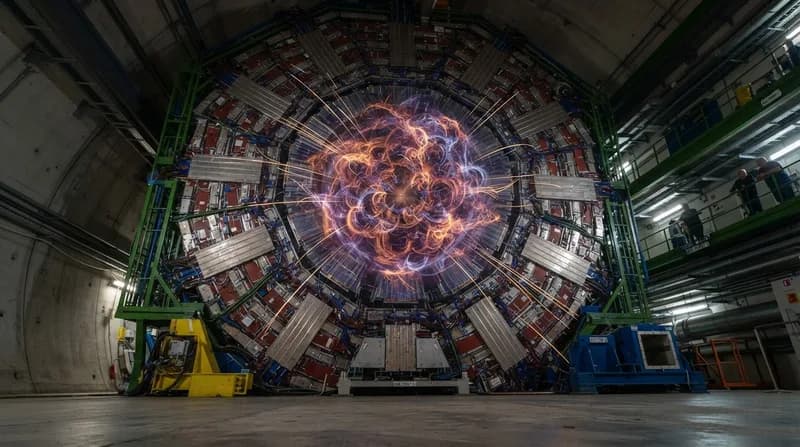
In the first micro-seconds following the Big Bang, the universe was not the cold, expansive void we see today. Instead, it was an unimaginably hot, dense state of matter known as quark-gluon plasma (QGP). Reaching temperatures of trillions of degrees, this substance existed for only a fraction of a second before cooling and condensing into the protons and neutrons that form the building blocks of all known matter. For years, physicists have theorized about the properties of this primordial soup, and now, researchers at CERN’s Large Hadron Collider have finally captured definitive proof of its liquid-like behavior.
A team of scientists led by physicists from MIT observed that when individual quarks blast through this dense plasma, they leave behind unmistakable ripples, splashes, and swirling wakes. Much like a duck paddling across a pond, the movement of a single quark through the QGP creates a disturbance, proving that the plasma behaves not as a collection of isolated particles, but as a unified, near-perfect fluid. This observation confirms long-standing theoretical models that predicted this "liquid" state would exhibit nearly zero friction.
The Z Boson Breakthrough
The primary challenge in documenting these wakes has always been the chaotic environment of particle collisions. Historically, researchers looked for pairs of quarks and antiquarks moving in opposite directions. However, because both particles generate their own disturbances, the individual signals would overlap, effectively masking the evidence of the wakes. To bypass this, the research team employed a novel "tagging" method using Z bosons.
A Z boson is an elementary neutral particle that interacts very weakly with the plasma, allowing it to act as a clean reference point. By colliding heavy ions and searching for events where a Z boson was produced alongside a single high-momentum quark, the team could isolate the quark’s movement. Because the Z boson passes through the plasma without significant interaction, any ripples detected in the direction opposite to the boson could be attributed solely to the quark. Among 13 billion collision events, the team successfully identified approximately 2,000 instances that clearly mapped the liquid-like wake of a lone quark.
Why it Matters
- Understanding the Primordial State: This experiment provides a real-time snapshot of the universe just microseconds after its birth, confirming that QGP acts as a dense, fluid-like substance.
- Validating Theoretical Models: The results provide the first direct experimental support for the "hybrid model" of QGP, which suggests energetic particles will consistently generate detectable wakes in the plasma.
- New Research Pathways: By analyzing the size, speed, and decay of these wakes, physicists can now study the specific physical properties of the QGP, such as its viscosity and cooling rate, with unprecedented precision.
This study, which was supported by the U.S. Department of Energy and involved the global CMS Collaboration, marks a significant milestone in high-energy physics. By treating the Z boson as a cosmic tag, researchers have gained a new lens through which they can observe the earliest, hottest, and most chaotic moments of our universe's history.