The Case of the Silent Collapse
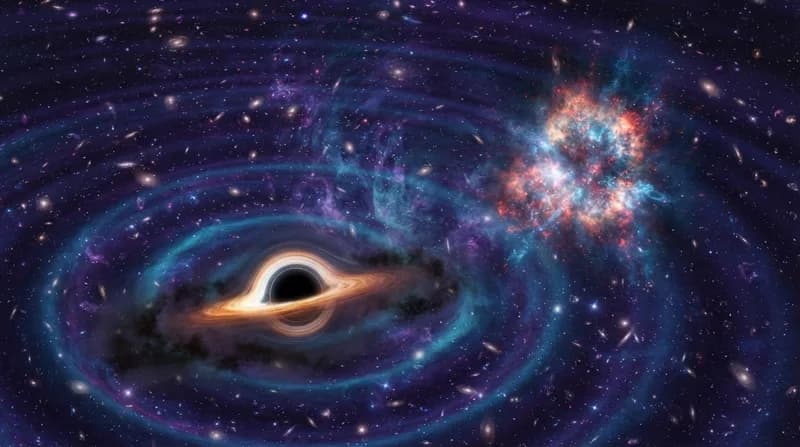
For decades, the narrative of a massive star's death has been dominated by the supernova—a cataclysmic explosion that tears the heavens apart, scattering elements across the cosmos while leaving behind a dense core. However, a compelling new study from researchers at Caltech suggests that a large portion of the universe's black hole population may have arrived via a much quieter, more secretive route. By analyzing data from 257 black hole mergers detected by the LIGO, Virgo, and KAGRA network, scientists have uncovered patterns that point toward "failed" supernovae, where a star collapses directly into a black hole without the typical outward-facing pyrotechnics.
This research, published in Physical Review D, posits that if stars can vanish from the visible sky, leaving behind a dark, unseen compact object, it would solve a major mystery regarding the distribution of mass among black holes. Because these events produce no brilliant light show, they have been nearly impossible to track using traditional telescopes. Now, by "listening" to the ripples in spacetime generated during black hole collisions, astronomers are gaining a clearer picture of how these invisible giants are born.
The Mass Distribution Mystery
The core of the study hinges on a striking statistical anomaly in the gravitational wave catalog. Researchers found an overwhelming abundance of black holes weighing approximately 10 times the mass of the Sun. In fact, these specific objects appear in nearly 75% of the merger events studied. Even more intriguing is a "missing" category: a noticeable scarcity of black holes with masses between 12 and 16 solar masses. This gap acts as a cosmic fingerprint, suggesting that there is a specific physical mechanism—or "special cocktail" of conditions—that preferentially produces 10 solar-mass black holes.
Beyond the mass distribution, the team analyzed the spin rates of these black holes. They discovered that the objects clustered around the 10-solar-mass mark also shared similar rotational characteristics. When combined with the mass findings, these patterns indicate that these black holes are not just a random collection of objects, but a distinct subpopulation that likely shares a common, non-supernova origin. The research provides a foundational step in connecting high-energy gravitational wave data with the underlying astrophysics of stellar evolution.
Why It Matters
Understanding how black holes form is essential to mapping the history of the universe. If a significant fraction of black holes are created through silent collapses, it fundamentally shifts our understanding of stellar lifespans and the recycling of elements in galaxies. Conventional supernovae act as cosmic "seeders," distributing heavy metals across space; a silent collapse would effectively lock that material away forever, altering the chemical composition of the interstellar medium. As gravitational wave observatories continue to refine their sensitivity, these "dark" events will become increasingly central to our understanding of the life and death of stars.