The End of Joint Replacement?
For millions of people, osteoarthritis is a degenerative path that frequently leads to one conclusion: total knee or hip replacement. Because articular cartilage—the smooth tissue that cushions our joints—has a notoriously poor capacity for self-repair, medical treatment has historically been limited to symptom management or invasive surgery. However, a groundbreaking study from Stanford Medicine suggests that this narrative could be about to change, with researchers identifying a way to rejuvenate existing cartilage cells and actively regrow lost tissue.
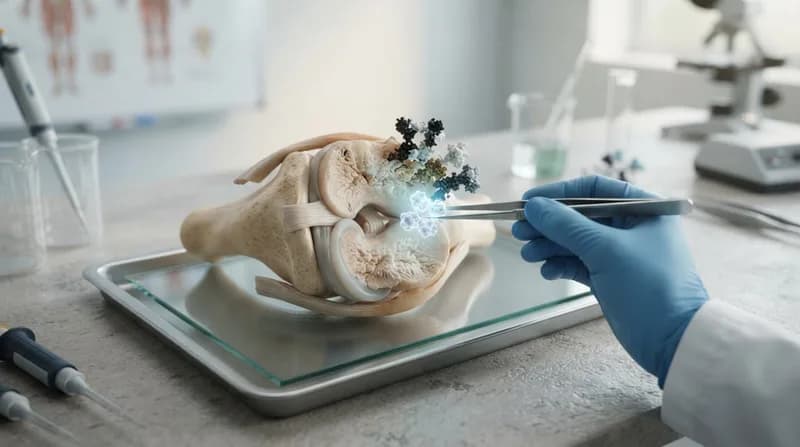
The study, recently published in the journal Science, centers on an enzyme known as 15-PGDH. Scientists have identified this protein as a 'gerozyme'—a term used to describe enzymes that increase in abundance with age and actively contribute to the deterioration of tissue function. By blocking the activity of 15-PGDH, researchers have successfully stimulated the regrowth of healthy hyaline cartilage in aging mice, offering a potential blueprint for a future where osteoarthritis is treated with an injectable or oral medication rather than a scalpel.
The Biological Mechanism
The discovery is particularly significant because it bypasses the need for stem cell recruitment. In many tissue repair models, researchers look to stem cells to replace damaged tissue; however, in the case of knee cartilage, those cells are difficult to source and manipulate. Instead, the Stanford team found that blocking 15-PGDH forces existing cartilage cells, known as chondrocytes, to shift their gene expression toward a more youthful, regenerative state.
This shift is crucial for two reasons. First, it reduces the activity of genes associated with inflammation and the degradation of collagen, which is the primary cause of joint pain. Second, it promotes the production of hyaline cartilage—the specialized, slippery surface required for pain-free joint movement—rather than fibrocartilage, which is a less effective, scar-like tissue. By inhibiting 15-PGDH, the researchers were able to see a dramatic, spontaneous thickening of cartilage across the surface of the joint, effectively reversing damage caused by age.
Promising Human Tissue Trials
While the initial success in mice is encouraging, the potential for human application is what has the medical community buzzing. In experiments using human cartilage samples harvested from patients undergoing knee replacement surgeries, the 15-PGDH inhibitor produced a similar response to that seen in the animal models. After just one week of exposure to the inhibitor, the human tissue samples showed a decrease in inflammatory gene activity and, most notably, began to produce new, functional articular cartilage.
This observation suggests that even in joints severely damaged by osteoarthritis, the existing cells retain the latent capacity for regeneration if the biological 'brakes'—in this case, 15-PGDH—are removed. Because 15-PGDH inhibitors are already being explored in clinical trials for age-related muscle weakness, the path to testing this therapy in human joint patients may be significantly shorter than that of a brand-new, untested pharmaceutical compound.
Outlook and Future Implications
The implications of this discovery are vast. Osteoarthritis affects roughly one in five American adults, incurring billions of dollars in annual healthcare costs. If a drug can be developed to prevent the disease's progression after an injury—such as an ACL tear—or reverse age-related degeneration, it would fundamentally change the landscape of orthopedics. Researchers are now looking toward launching clinical trials to determine safety and efficacy, with the ultimate hope of providing a non-surgical alternative to joint replacement that preserves the patient’s natural anatomy.