The Breakdown of an Ancient Mutualism
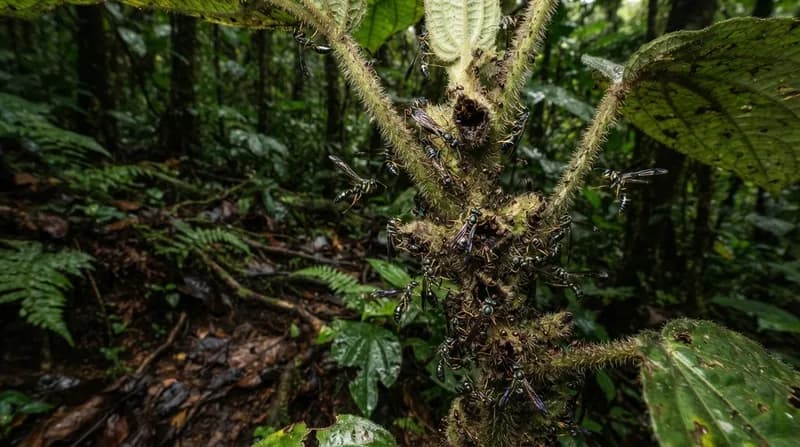
In the dense tropical forests of Malaysian Borneo, an ecological drama is unfolding inside the stems of the Macaranga pearsonii, a plant species known as an "ant-plant." For over ten million years, these trees have engaged in a sophisticated mutualistic partnership with specific ant colonies. The trees provide specialized hollow chambers and nutritious food bodies to support the ants; in return, the ants aggressively defend the trees against leaf-eating insects. However, recent field research indicates that this long-standing alliance is under threat from an unexpected intruder: the predatory wasp.
The Wasp Infiltration
Researchers from an international collaboration, including Queen Mary University of London and the Royal Botanic Gardens, Kew, have observed these predatory wasps moving into the plant chambers that were strictly intended for their ant partners. Unlike the ants, which act as protective sentinels for the tree, these wasps use the hollow stems for purely reproductive ends. The scientists discovered that the wasps paralyze flies and store them inside these plant cavities, creating a larder for their developing larvae. Essentially, the wasps are repurposing the tree's defensive architecture into a series of nurseries, thereby rendering the plant’s investment in its ant allies useless.
Impact of Human-Altered Landscapes
The study highlights a troubling correlation between human environmental disturbance and the success of these invasive wasp behaviors. Researchers compared Macaranga pearsonii trees in logged forest areas to those in oil palm plantations. The findings revealed a much higher prevalence of wasp occupation in the plantation zones. Trees infiltrated by wasps consistently exhibited significantly smaller ant colonies, suggesting that the wasps are effectively displacing the plant’s primary defenders. As these plantations and disturbed landscapes expand, the frequency of such ecological "hijacking" appears to be accelerating.
Why It Matters
This development has profound implications for tropical forest recovery and evolutionary biology. Macaranga species are foundational "pioneer" plants—they are often the first to establish themselves in degraded or cleared areas. Because their health and survival are intrinsically linked to their ant defenders, the loss of these guards could lead to less resilient forests. If the plants stop producing these hollow chambers because the investment no longer yields a defensive benefit, the long-term evolutionary trajectory of the species could be permanently altered. This subtle disruption is a stark reminder that the negative impacts of human activity on ecosystems often manifest long before a species faces total extinction.