ScienceTechnical Deep Dive

Quantum Leap: Scientists Simulate Matter Creating Itself from Pure Energy

Published
EElectricBuzz Editorial Team
Quantum Leap: Scientists Simulate Matter Creating Itself from Pure Energy
3 min read513 wordsElectricBuzz Editorial Team

The Gist

“Researchers have successfully used a trapped-ion quantum simulator to observe the fundamental physics of 'string breaking,' a phenomenon that mimics how matter formed in the early universe.”

Replicating the Dawn of Time

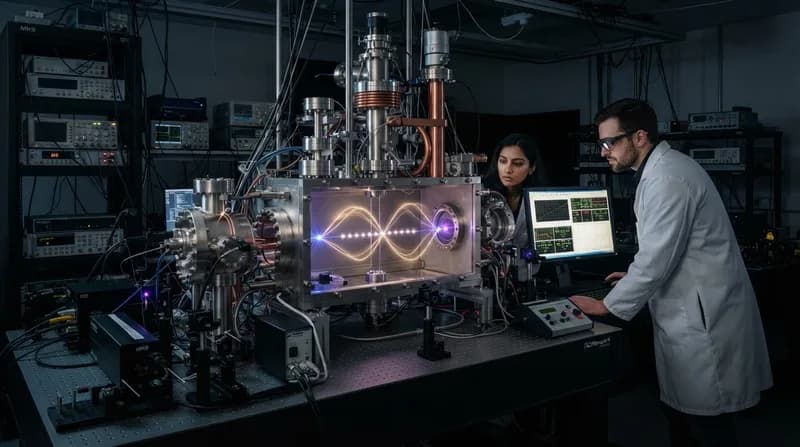
In a groundbreaking experiment that bridges the gap between atomic computing and high-energy cosmology, a team led by the Duke Quantum Center (DQC) has successfully simulated a process known as string breaking. By utilizing a 13-ion quantum simulator, researchers were able to observe particles effectively "popping into existence," a physical dynamic that provides a rare window into the extreme conditions that existed moments after the Big Bang.

The study, published in Nature Physics, highlights the growing capability of trapped-ion quantum computers to solve complex problems in fundamental physics. While phenomena like string breaking require immense energy levels typically found only in particle accelerators like the Large Hadron Collider, this quantum platform allows for precise, controlled observation of these dynamics at a much more manageable scale.

Understanding Quarks and String Breaking

At the heart of the research is the behavior of quarks, the fundamental building blocks of matter found within protons and neutrons. In the physical world, quarks are never found in isolation because they are bound together by a force that acts like a string. As scientists pull these quarks apart, the energy in the "string" increases until it reaches a breaking point.

According to Einstein’s famous equation, E=mc², this massive accumulation of energy does not simply vanish when the string snaps. Instead, that energy converts directly into mass, creating new particle-antiparticle pairs. This "popping into existence" is a cornerstone of how the early universe transitioned from pure energy into the matter we see today. By encoding this model into a chain of 13 trapped ions and utilizing precisely timed laser pulses, the researchers created an environment where they could manipulate energy states to mirror this subatomic transformation.

Why It Matters

  • Quantum Superiority: While current results were verified by classical computers, the experiment demonstrates a path toward simulations that will eventually exceed the capacity of even the world’s most powerful supercomputers.
  • Cosmological Insight: By simulating out-of-equilibrium physics, researchers can "rewind" the tape of the universe, testing theories about how matter evolved in the seconds following the Big Bang.
  • Hardware Diversification: The research serves as a major benchmark for the quantum field, showing that different platforms—including trapped ions, superconducting circuits, and neutral atoms—can converge on the same physical truths.

The Future of Quantum Simulation

The success of the Duke-led team, which included collaborators from UMD, Oxford, Caltech, and other prestigious institutions, marks a shift in how we approach particle physics. By using a "laboratory on a chip" approach, scientists no longer have to rely solely on massive, multi-billion dollar collision experiments to study subatomic dynamics. Instead, they can program quantum hardware to behave according to the laws of the early universe.

As these quantum simulators scale in size and complexity, the researchers believe they will be able to investigate phenomena that remain impossible to replicate in any terrestrial laboratory. This isn't just about recreating the past; it’s about creating a new toolset that allows physicists to test the limits of the Standard Model and potentially discover new physical laws governing the behavior of matter at its most fundamental level.
SPONSORED
The 5 Best Over-Ear ANC Headphones of 2026, Tested & Ranked
Editor's Pick Guide
92/100
Tech & Gadgets•12 min read

The 5 Best Over-Ear ANC Headphones of 2026, Tested & Ranked

We locked five over-ear ANC picks for 2026 — Sony WH-1000XM6, Bose QuietComfort Ultra 2, Soundcore Space One, Sennheiser Momentum 5, and Apple AirPods Max 2 — then stress-tested them on lab metrics, long-term owner truth, and live street prices.

Related Stories

Semantically matched articles, ranked by topic overlap and freshness.

Rewriting Earth’s History: Rethinking a 2-Billion-Year-Old Geological Puzzle
Science

Rewriting Earth’s History: Rethinking a 2-Billion-Year-Old Geological Puzzle

New research suggests a landmark chemical signature from Earth's past, once thought to represent a global climate event, may actually be the result of localized volcanic heating.

The REM Paradox: Why Your Brain Works Overtime While You Sleep
Science

The REM Paradox: Why Your Brain Works Overtime While You Sleep

New research from Tohoku University reveals that the brain's energy consumption spikes during REM sleep, even as the body attempts to bolster its fuel supply.

The Invisible Danger: How Scented Cleaners Create Indoor Air Pollution
Science

The Invisible Danger: How Scented Cleaners Create Indoor Air Pollution

New research from Purdue University reveals that the 'fresh' scent of household cleaners triggers chemical reactions, releasing billions of lung-penetrating nanoparticles into your home.

Smartwatch Calorie Tracking: Why Body Composition Matters
Science

Smartwatch Calorie Tracking: Why Body Composition Matters

A new study reveals that popular wearable devices struggle to accurately track calories, with error rates spiking significantly in users with higher body fat percentages.

Beyond Appetite: How Tirzepatide Could Unlock Fat-Burning Potential
Science

Beyond Appetite: How Tirzepatide Could Unlock Fat-Burning Potential

A groundbreaking study in mice reveals that popular weight-loss drugs Mounjaro and Zepbound may actively trigger the body's calorie-burning brown fat, offering new hope for metabolic health.

Bitget Crypto Exchange Hit by $387.5 Million Heist Linked to North Korean Actors
Science

Bitget Crypto Exchange Hit by $387.5 Million Heist Linked to North Korean Actors

Major crypto exchange Bitget has confirmed a massive $387.5 million security breach, with leadership pointing to state-sponsored North Korean actors as the likely culprits.

Hidden in the Rocks: Two New Snail Species Discovered in Montenegro's Rugged Canyons
Science

Hidden in the Rocks: Two New Snail Species Discovered in Montenegro's Rugged Canyons

Scientists and citizen researchers have identified two unique, trapdoor-shutting snail species in Montenegro, highlighting both the region's hidden biodiversity and the urgent threats posed by industrial development.

Landmark Swedish Study Links Congenital Infections to Neurodevelopmental Risks
Science

Landmark Swedish Study Links Congenital Infections to Neurodevelopmental Risks

A massive longitudinal study tracking 3.7 million individuals reveals that rare prenatal infections significantly elevate the risk of autism and intellectual disabilities later in life.