A Bridge Across Physics
For nearly a century, modern physics has operated on a split foundation. Quantum mechanics offers a precise, albeit strange, map of the subatomic universe, while Einstein’s theory of general relativity serves as the gold standard for describing gravity and the massive structures of the cosmos. Despite their individual successes, these two frameworks have refused to reconcile, leaving the search for a unified theory of everything one of the greatest challenges in scientific history. However, a major breakthrough has brought us a step closer to this unification.
An international team of researchers, including Nobel laureate Sir Roger Penrose, has successfully observed a long-predicted gravitational effect on a falling quantum object. By utilizing ultracold rubidium atoms, the team demonstrated that Einstein’s foundational equivalence principle—which posits that gravity effectively vanishes for an observer in free fall—holds true even when applied to quantum particles. This discovery, published in Science Advances, provides a crucial empirical data point in the ongoing struggle to bridge the gap between gravity and quantum mechanics.
The Quantum Galileo Interferometer
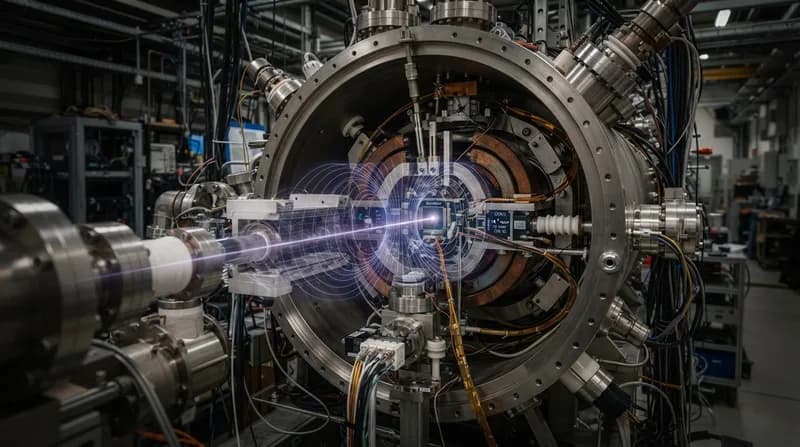
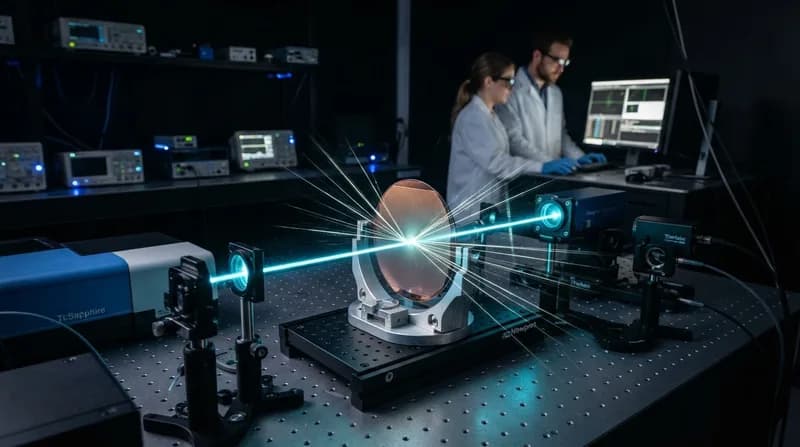
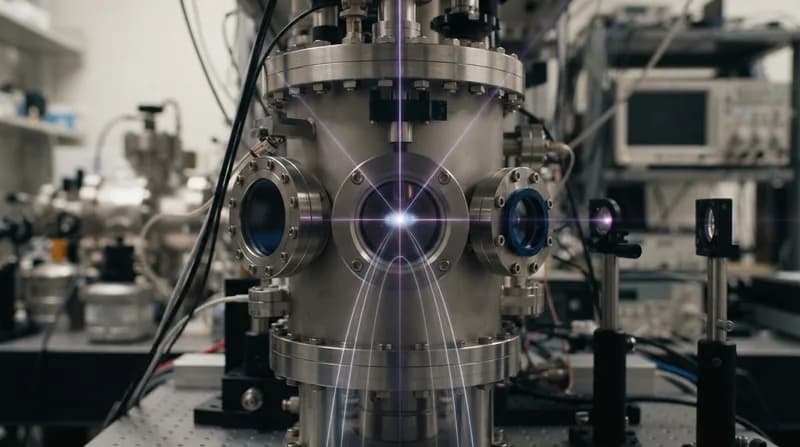
To conduct this experiment, the team developed a specialized piece of hardware known as the Quantum Galileo Interferometer. The device works by manipulating rubidium atoms cooled to temperatures just fractions of a degree above absolute zero. At these extreme temperatures, atoms exhibit wavelike characteristics, allowing researchers to place them into a state of quantum superposition, where they effectively exist in multiple locations at once.
Using a highly precise atom chip equipped with integrated microwave pulses and magnetic field controllers, the team split the quantum wave of a single atom. While one segment of the wave was held stationary via a precisely calibrated magnetic force, the other was allowed to fall under the influence of gravity. After the fall, a second magnetic pulse was used to reunite the two waves. By analyzing the interference pattern produced, the researchers were able to measure the tiny, predicted phase shift that gravity induced on the falling portion of the atom.
Why It Matters
- Validation of Foundations: The study confirms that the Equivalence Principle remains robust at the quantum scale, reinforcing Einstein’s core logic under conditions where quantum behavior is dominant.
- New Experimental Frontiers: The development of the Quantum Galileo Interferometer creates a new toolkit for probing the intersection of gravity and particle physics.
- Refining Future Theories: While this experiment doesn't provide a unified theory of gravity and quantum mechanics, it sets a necessary baseline for where quantum behavior remains consistent with classical physics, narrowing the search parameters for new, more comprehensive models.
- Future Scalability: The research team is already looking toward testing even more massive particles, such as nanodiamonds, which could eventually test theories regarding the breakdown of quantum superpositions in large objects.
Implications for the Future
While the results confirm that Einstein’s principle remains consistent in the explored range, the experiment opens the door to much more ambitious tests. The current study did not possess the mass required to test whether quantum mechanics might eventually 'break down'—an idea suggested by Sir Roger Penrose, who theorizes that quantum superposition may fail when applied to sufficiently large, massive objects. The research team is already preparing to scale these experiments to higher masses, potentially offering a definitive look at whether gravity eventually forces quantum reality into a more classical state. This experiment serves as more than just a measurement; it is a clear indicator that the boundary between the subatomic and the astronomical is starting to yield to human inquiry.