The Millisecond Frontier of Fusion Energy
Nuclear fusion—the process that powers the sun—represents the ultimate goal for clean, virtually limitless energy. However, harnessing this power on Earth requires confining plasma, a superheated state of matter, within complex machines known as tokamaks. Keeping this plasma hot, dense, and stable is a monumental engineering challenge. Plasma instabilities can emerge and escalate within mere thousandths of a second, moving far too quickly for any human operator to intervene. Now, a team at the Princeton Plasma Physics Laboratory (PPPL) and Princeton University has bridged this speed gap with a groundbreaking artificial intelligence framework called PACMAN (Prediction And Control using MAchiNe learning).
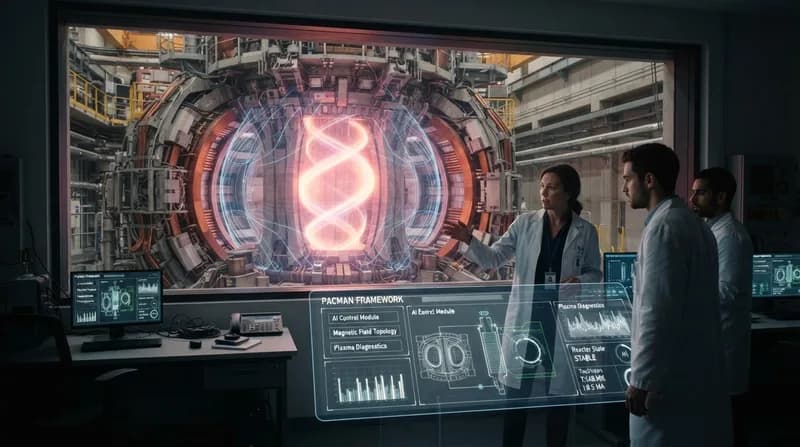
PACMAN serves as a sophisticated, modular software infrastructure that allows multiple AI models to communicate and execute real-time adjustments to a tokamak’s heating systems, magnets, and gas injectors. While previous efforts in AI fusion control were often fragmented or limited in scope, PACMAN offers a unified, high-speed loop. By operating in cycles as fast as 20 milliseconds, the system can continuously monitor conditions and react to subtle disturbances before they evolve into mission-ending disruptions.
How PACMAN Functions
The framework operates like a high-speed, four-stage assembly line, ensuring that AI-driven decisions remain within safe operational boundaries. First, the system ingests live telemetry—including temperature, magnetic signals, and density readings—from the tokamak. These signals are validated and synchronized into a unified data package. In the second stage, specialized AI models analyze these inputs to estimate current plasma states and forecast future behavior.
Third, control algorithms determine the necessary physical adjustments, such as modulating heating beams or repositioning magnetic mirrors. Finally, the system resolves any conflicting commands, verifies them against hard-coded hardware safety limits, and executes the instructions. This architecture allows researchers to plug in new AI models or swap existing ones without needing to reconfigure the entire system, significantly accelerating the pace of experimental iteration.
Why it Matters
- Predictive Capability: PACMAN can anticipate instabilities, such as tearing modes, up to 200 milliseconds before they occur, allowing for preemptive stabilization rather than reactive suppression.
- Human-in-the-Loop: Despite its autonomy, the framework maintains strict safety protocols. Human operators define the high-level objectives, and the system cannot override core hardware safety limits.
- Modularity: The flexible, building-block nature of the framework means it can be adapted to various tokamak designs, making it a scalable infrastructure for the global fusion research community.
- Enhanced Performance: By simultaneously coordinating multiple hardware components—such as all six gyrotrons on the DIII-D facility—the AI achieved optimal control patterns that were previously unachievable through standard algorithms.
Proven Performance in the Field
The effectiveness of PACMAN was recently validated through five successful experiments at the Department of Energy’s DIII-D National Fusion Facility. In these tests, the AI demonstrated remarkable versatility by successfully managing reinforcement learning-based heating control, predicting plasma-edge energy bursts, and mitigating complex wave instabilities driven by fast particles. Perhaps most impressively, the system proved its ability to learn and adapt; after the initial installation took several months, the integration of a second, independent model was completed in just a few days, drastically reducing the time required for testing and debugging.
As fusion research transitions from theoretical modeling to operational infrastructure, tools like PACMAN are essential for making reactors viable. By automating the most volatile aspects of plasma control, this technology allows physicists to focus on higher-level scientific objectives, confident that the system is responding at speeds that would otherwise be impossible to manage.