A New Frontier in Quantum States
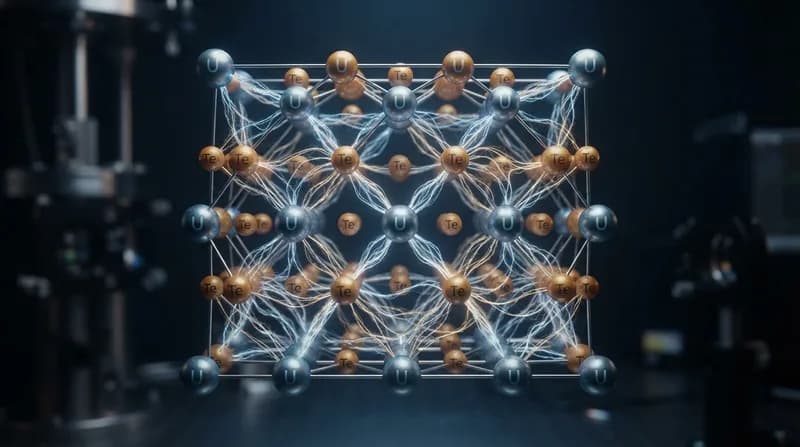
In a groundbreaking discovery that could reshape our understanding of quantum matter, physicists at the University of Illinois Urbana-Champaign’s Grainger College of Engineering have detected evidence of a long-theorized but elusive state of matter known as a pair density wave (PDW). By studying uranium ditelluride—a material that behaves in ways far outside the norms of conventional metal physics—researchers have finally observed the 'ghost' of superconductivity, where the fundamental building blocks of the superconducting state remain intact long after the macroscopic property itself has disappeared.
Superconductivity is typically defined by a material’s ability to conduct electricity with zero resistance. To achieve this, individual electrons form 'Cooper pairs.' In traditional superconductors, these pairs emerge only once the material hits a specific critical temperature. However, the new research confirms that in uranium ditelluride, these pairs organize into rippling patterns that persist above the transition point, functioning as a structural vestige of the superconducting state.
The Nature of Pair Density Waves
To understand the significance of this discovery, one must consider the historical context of BCS theory, the 1957 framework that explains standard superconductivity. Under BCS, electrons form Cooper pairs that allow them to bypass the typical repulsive forces between fermions, enabling a condensation into a zero-resistance state. The emergence of 'unconventional' superconductors in the 1980s challenged this model, leading to the 2007 prediction by Eduardo Fradkin and his team that Cooper pairs might form repeating, non-uniform patterns—or PDWs—prior to the actual superconducting phase.
Previously, identifying these waves was nearly impossible because they mimic other electronic states, such as charge density waves (CDWs). The researchers found that in uranium ditelluride, these states are uniquely sensitive to magnetic fields. By utilizing high-quality crystal samples and advanced vector magnetic field scanning tunneling microscopy, the team proved that these PDW modes respond to temperature and magnetism exactly as theory predicted, providing the most robust evidence to date for the existence of this hidden phase.
Why It Matters
- Redefining Phases: The discovery suggests that electron pairing is not merely a consequence of the superconducting transition, but may actually be a prerequisite state that forms in advance.
- Unconventional Behavior: Uranium ditelluride is increasingly viewed as a triplet-pair superconductor, placing it in a rare category similar to superfluid helium-3.
- Technological Implications: Understanding how to manipulate these 'ghost' states could eventually lead to more stable, high-temperature superconducting materials, which are the backbone of future quantum computing and lossless energy transmission.
Overcoming Experimental Obstacles
The success of the experiment hinged on the ability to cultivate ultra-high-quality uranium ditelluride crystals. Previous attempts to observe these patterns were hampered by material impurities, which obscured the spectral signatures of the PDWs. By employing a new molten flux growth method, the research team created samples clear enough to isolate the signal from the 'fog' of impurities.
Furthermore, the use of vector-magnet equipment allowed for precise measurements across multiple directions. Because uranium ditelluride is highly anisotropic—meaning its physical properties vary depending on the direction of the measurement—this equipment was essential to confirm that the observed waves were indeed intrinsic to the material's quantum structure rather than external noise. While this study currently measures surface behavior, it provides a compelling roadmap for interior analysis and marks a major victory for condensed matter physics.